


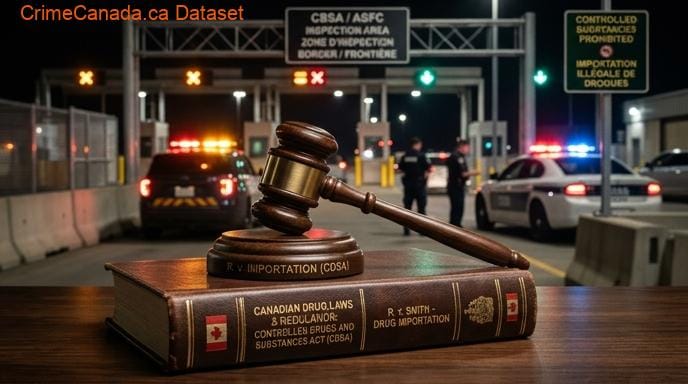
Importing or exporting controlled substances under Section 6 of the Controlled Drugs and Substances Act (CDSA) is one of the most serious drug offenses in Canada. This crime, classified as an indictable offence under Uniform Crime Reporting (UCR) Code 4330, targets the cross-border movement of regulated drugs without lawful authorization. In simple terms, it covers bringing drugs into Canada from another country or sending them out of Canada, whether by land, air, sea, mail, or courier. Because cross-border drug movement is closely linked to organized crime and international trafficking, Parliament has authorized very severe penalties, including mandatory minimum jail terms in some situations and a maximum of life imprisonment. This article explains the law on controlled substances import export Canada in clear, practical language, based on Section 6 CDSA and related legal principles.
The Legal Definition
Section 6(1), Controlled Drugs and Substances Act (CDSA): No person shall import into Canada or export from Canada a substance included in Schedule I, II, III, IV, V or VI, except as authorized under the regulations.
Section 6(2), CDSA (paraphrased for clarity): No person shall, for the purpose of trafficking, import into Canada or export from Canada a substance included in Schedule I, II, III, IV, V or VI, or any substance represented or held out to be such a substance, except as authorized under the regulations.
In plain English, Section 6 makes it a crime to bring controlled substances into Canada or send them out of Canada without proper legal authorization (such as a licence, permit, or exemption under federal regulations). The law applies to substances listed in the CDSA schedules, which include drugs such as heroin, cocaine, fentanyl, methamphetamine, many prescription medications, and precursor chemicals used to make illegal drugs. It does not matter whether the person is physically carrying the drugs across the border or arranging for them to be shipped by others; if they are responsible for having the drugs imported or exported, they may be charged.
Subsection 6(2) adds a further layer: where the importation or exportation is for the purpose of trafficking (for example, to sell, give, or distribute the drugs), that purpose becomes an aggravating factor. The section also covers situations where the substance is not actually a controlled drug but is falsely represented as one. The statute allows lawful imports and exports only through tightly controlled regulatory frameworks—for example, licensed pharmaceutical companies or authorized medical and scientific uses. Anyone outside those regulated channels who imports or exports controlled drugs risks prosecution under Section 6. The official text and current schedules are available on the Department of Justice website at Section 6 CDSA.
Penalties & Sentencing Framework
- Offence classification: Indictable offence (no summary option).
- Maximum penalty: Life imprisonment.
- Mandatory minimum penalty: At least 1 year of imprisonment if specified aggravating factors are present (for example, importing or exporting for the benefit of a criminal organization, involving use of a weapon or violence, or other statutory triggers).
- Additional consequences: Potential forfeiture of offence-related property, significant fines, immigration consequences for non-citizens, and long-term restrictions on travel and employment.
Section 6 import/export charges are always prosecuted by indictment. That means there is no “summary conviction” version with lower maximum penalties. The Crown can seek very lengthy sentences where the quantity of drugs is large, where the drugs are particularly dangerous (such as fentanyl or heroin), or where there are links to organized crime or sophisticated smuggling operations. The absolute ceiling is life imprisonment, reflecting Parliament’s intention to treat cross-border drug crime as among the most serious offences in Canadian criminal law.
While the general maximum is life, the sentencing range in a particular case depends on factors such as the type and quantity of drug, the offender’s role in the operation, their criminal record, and whether there are mandatory minimums. When certain aggravating factors are present, the law imposes a mandatory minimum penalty of at least one year in jail. These factors typically include situations where the offender imported or exported drugs for the benefit of, at the direction of, or in association with a criminal organization, or used violence, weapons, or other aggravating conduct. In such cases, the sentencing judge cannot go below the statutory minimum, even if there are strong mitigating personal circumstances.
Where mandatory minimums do not apply, judges still impose significant custodial sentences for import/export offences. Even first-time offenders involved in relatively small quantities can face years in prison, especially for hard drugs like cocaine or methamphetamine. Sentences also tend to be higher than for simple possession or even domestic trafficking because cross-border drug movement is viewed as fueling broader international markets and undermining border security. For non-citizens, a conviction for a serious indictable drug offence will almost always trigger serious immigration consequences, including inadmissibility and potential deportation.
Common Defenses
-
Lack of Knowledge
To convict under Section 6, the Crown must prove that the accused knowingly imported or exported a controlled substance. A common defense is to argue that the person did not know drugs were present—for example, they were given a suitcase, vehicle, or shipment they believed to contain only legitimate goods. In these cases, the defense will focus on creating a reasonable doubt about knowledge: Were there obvious signs of tampering? Did the person have a plausible, consistent explanation for why they were transporting the goods? Did someone else have exclusive control over the contents? If the court accepts that the accused honestly did not know about the drugs, or at least finds a reasonable doubt about their knowledge, they must be acquitted. However, courts will examine claims of ignorance very carefully, particularly where circumstances were suspicious or the accused deliberately avoided checking what they were transporting (sometimes called “willful blindness”).
-
Mistaken Identity
Mistaken identity can arise where the Crown’s case depends heavily on surveillance, border camera footage, or documentation that may not clearly link a specific individual to the drugs. For instance, in complex import/export cases, multiple people may have had access to a shipment or container. The defense may argue that the police arrested the wrong person, that the accused’s name or ID was misused, or that video or photo evidence is unclear. Where identification evidence is weak—poor quality images, inconsistent eyewitness accounts, or unreliable border records—the defense can challenge whether the Crown has proven beyond a reasonable doubt that this particular accused was the person who imported or exported the drugs. In serious drug cases, courts demand strong, reliable identification evidence before convicting.
-
Duress or Coercion
Duress (also called coercion) recognizes that a person may commit an offence because they were forced to do so by threats of death or serious bodily harm. In the context of controlled substances import export Canada cases, this might involve a situation where organized crime groups threaten the accused or their family unless they act as a courier. To rely on duress, the accused must typically show that there was a serious and immediate threat, that there was no safe way to avoid committing the offence (such as going to the police), and that there was a close link between the threat and the illegal act. Canadian courts treat duress cautiously and apply strict legal tests, especially in serious drug cases, but where the evidence supports it, duress can provide a full defence and lead to an acquittal.
-
Violation of Charter Rights
Because Section 6 offences almost always involve border searches, vehicle inspections, luggage searches, and sometimes wiretaps or undercover operations, the Canadian Charter of Rights and Freedoms plays a critical role. Common Charter issues include alleged breaches of the right to be free from unreasonable search and seizure (section 8), the right to counsel (section 10(b)), and the right not to be arbitrarily detained (section 9). For example, if border officers or police exceeded their lawful authority in searching a person’s body cavities, luggage, or electronic devices, or if they failed to promptly inform the accused of their right to speak with a lawyer, the defense may bring a Charter application. If the court finds a breach and concludes that admitting the evidence (such as the seized drugs) would bring the administration of justice into disrepute, the evidence can be excluded under section 24(2) of the Charter. Without the drugs as evidence, the Crown’s case may collapse, leading to an acquittal or a withdrawal of charges.
Real-World Example
Consider this scenario: a person conceals several kilograms of cocaine within a shipment of legal goods—such as electronics or clothing—and attempts to bring it through Canadian customs without declaring the controlled substance. The shipment arrives at a Canadian port of entry. Border officers, using risk indicators or random selection, choose to inspect the cargo. During the search, they discover the hidden packages of cocaine. The importer is identified through shipping documents and surveillance footage and is arrested.
In this example, the conduct clearly falls within Section 6 CDSA: the individual has arranged to import a Schedule I controlled substance (cocaine) into Canada without authorization. Because of the quantity and the method of concealment, the Crown would likely allege that the importation was for the purpose of trafficking, making the offence more serious. The accused would be charged with an indictable offence carrying a maximum of life imprisonment. The court would consider factors such as the scale of the operation, the accused’s role (organizer versus low-level courier), any prior criminal record, and possible connections to organized crime. If aggravating factors that trigger mandatory minimum sentences are proven—such as involvement of a criminal organization—the judge would be required to impose at least the statutory minimum term of imprisonment, and likely much more.
Record Suspensions (Pardons)
A conviction for importing or exporting controlled substances under Section 6 of the CDSA results in a permanent criminal record unless a record suspension (formerly called a pardon) is obtained. Because this is an indictable offence and categorized as a serious drug crime, the waiting period before applying for a record suspension is longer than for less serious offences. For indictable convictions, eligibility to apply typically begins 10 years after completion of the entire sentence, which includes jail time, probation, and payment of any fines or surcharges. The Parole Board of Canada assesses applications on a case-by-case basis, considering the nature of the offence, conduct since the conviction, and evidence of rehabilitation.
Importantly, a record suspension does not erase the fact that the offence occurred; it sets the record apart from other criminal records in the Canadian Police Information Centre (CPIC) database and limits routine access to it. However, foreign authorities, particularly those of other countries such as the United States, are not bound by Canadian record suspensions and may still consider the original conviction when making immigration and border decisions. For anyone convicted of a Section 6 offence, especially one involving significant quantities or organized crime, legal advice is strongly recommended before pursuing a record suspension.
Related Violations
- Trafficking in Controlled Substances
- Possession for the Purpose of Trafficking
- Production of a Controlled Substance