


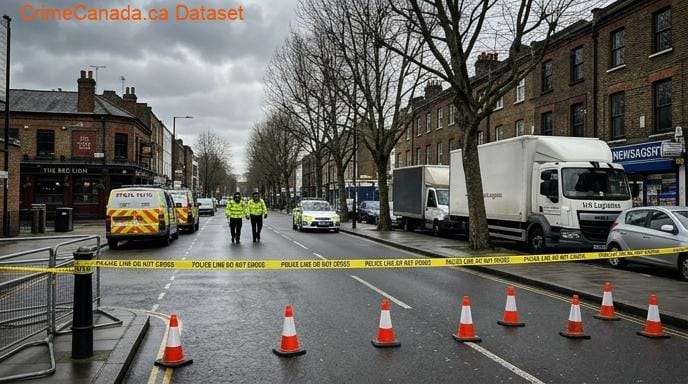
Toronto King West Shooting: Second Arrest Made as Police Warn Two Suspects Are Still Armed and Dangerous
Overview: What We Know About the King West Shooting Case
Police have charged a second suspect in connection with a fatal shooting in Toronto’s Entertainment District, almost five months after the incident. The case stems from a gunfire exchange near King Street West and Spadina Avenue in the early hours of November 25, 2025, that left 18-year-old Dylan Adams dead and sent another man to hospital.
Investigators allege that around 4:45 a.m., a 27-year-old man from Montreal, identified as Frandy Noel, was approached by a group of males who opened fire. Police say Noel was struck and is accused of shooting back, fatally wounding Adams. Adams was later pronounced deceased in hospital and recorded as Toronto’s 37th homicide of 2025. Noel was arrested the following day and charged with second-degree murder. As of the latest open-source review, there have been no reported changes to those charges and no additional official updates beyond the newly announced arrest.
New Charges and Ongoing Manhunt
On April 11, 2026, authorities announced the arrest of a second suspect, Zavion Boswell, 22, of Toronto. Boswell is facing five charges linked to the November 25 shooting, including manslaughter, robbery with a firearm, and three counts of possession of a restricted/prohibited firearm. Police say he was scheduled to appear in a Toronto court the same day the charges were publicized.
The investigation remains active. Canada-wide warrants are in place for two additional suspects, both from Montreal: 30-year-old Wissem Mohamed Rehayem and 26-year-old Steven Brice Pierre. They are wanted on several firearm-related offences and are described by police as armed and dangerous, with connections to both Toronto and Montreal. No public record of their arrest or court appearance has been identified in subsequent open-source checks.
Community Context & Social Sentiment
The King West and Spadina area is a dense nightlife hub, with bars, restaurants, and late-night venues drawing large crowds, particularly on weekends. While downtown Toronto sees more reported crime than residential suburbs, the precise intersection involved in this case has not been highlighted in the last year as a recurring hotspot for shootings in publicly accessible police data. Instead, the broader downtown core typically records higher levels of assaults and robberies associated with large foot traffic, alcohol, and late-night activity.
Online reaction to this specific case has been limited. No widely shared posts or viral discussions clearly tied to this shooting were found on major platforms such as Reddit’s r/Toronto or recent X (Twitter) threads. Instead, current conversations around violence in Toronto tend to focus on overall trends: users note that homicides and shootings have declined from previous years, but many emphasize that the progress feels fragile, especially when high-profile incidents occur in busy, well-known areas like the Entertainment District.
For residents and visitors, the combination of falling citywide crime rates and occasional serious incidents creates a complex safety picture. People continue to frequent King West for dining and entertainment, but fatal events like this reinforce the importance of situational awareness—particularly in the very late overnight hours when alcohol consumption is higher and crowds thin out.
Although this incident is specific to Toronto, the pattern of concentrated nightlife-related crime is visible in many Canadian cities. Comparative local data, such as the Kingston Crime Statistics & Safety Report or profiles for smaller communities like Quinte West in Ontario, show how crime severity often clusters in commercial cores, while surrounding neighbourhoods can experience markedly different risk levels.
How This Case Fits Toronto’s Crime Trends
From a statistical perspective, the King West shooting occurred during a year when Toronto’s overall homicide and shooting numbers were declining sharply. Toronto recorded 39 homicides in 2025, down from 81 in 2024—a reduction of about 55%, putting the city on pace for one of its lowest homicide counts in roughly two decades. Within that total, fatal shootings were notably reduced: shootings fell by approximately 53.7%, to 19 incidents, according to compiled open-source summaries of police and media data.
Stabbings also declined, dropping about 45.5% to 12 incidents in the same timeframe. At a broader level, Toronto’s Crime Severity Index (CSI) has been tracked at about 59.4, which is lower than the national average of roughly 79.2. This indicates that, in aggregate, offences in Toronto are less severe than in many other parts of Canada, even though population density and urban factors mean residents experience more visible crime than in some smaller communities such as East River, Part 2 in Prince Edward Island or certain coastal areas in British Columbia.
Despite the improvements in lethal violence indicators, assaults remain the dominant major crime category in Toronto, accounting for roughly 54% of major crimes citywide. While there was a modest 2.4% decrease in assaults in 2025, they still far outnumber homicides or attempted murders. Robberies also showed a downward trend, with an estimated 18.7% reduction to approximately 2,531 reported cases.
Within this macro picture, the King West homicide stands out as an example of how a single confrontation involving multiple firearms can rapidly escalate into lethal violence in an otherwise busy, commercial area. It underlines law enforcement concerns about illegal gun possession, particularly where suspects travel between cities—here, between Montreal and Toronto—and potentially exploit nightlife environments to settle conflicts or commit targeted robberies.
For community safety planning, the key takeaway is that fewer shootings overall does not eliminate risk in hotspot time windows, such as the early morning hours on weekends. Coordinated policing strategies—visible patrols, focused enforcement on illegal firearms, and collaboration between cities connected by suspect movements—remain central to keeping homicide numbers from rebounding.
Public Safety Considerations
Given that two suspects remain wanted and are described as armed and dangerous, residents are urged to treat any sightings or knowledge of Wissem Mohamed Rehayem or Steven Brice Pierre as a police matter and not to approach them directly. The standard safety guidance in such cases is to call local authorities or emergency services immediately, providing as much detail as possible about location, appearance, and any vehicles involved.
For individuals frequenting the Entertainment District and similar venues:
- Try to travel in groups, especially between 1 a.m. and 5 a.m., when streets are less crowded and visibility is lower.
- Stay on main routes with good lighting and active foot traffic when leaving clubs, bars, or restaurants.
- If you witness any dispute escalating—particularly if weapons are visible or suspected—move to a safe distance and contact police rather than intervening.
While there is no current indication of an ongoing threat to the general public at King West and Spadina beyond the outstanding warrants, the case is a reminder that serious violence can occur even in well-known entertainment corridors that most people experience as safe.
About This Report
This safety alert was generated by aggregating data from local authorities, community reports, and open-source intelligence. Our mission at Crime Canada is to provide citizens with localized safety data and context. We are not the original creators of the underlying news reports.
Primary Source: Information in this report was initially covered by Denio Lourenco for CityNews.
Additional Research & Context
- Citywide homicide and shooting trends, including the decline from 81 homicides in 2024 to 39 in 2025, were synthesized from a summary of Toronto crime rate statistics for 2025.
- Context on Toronto’s overall homicide rate and long-term trends, as well as expert commentary on the 2025 decline, were drawn from a Global News analysis of Toronto’s falling homicide numbers.
- Comparative crime metrics and Crime Severity Index data were informed by Statistics Canada’s Crime Severity Index tables and public Toronto Police Service data portals.