


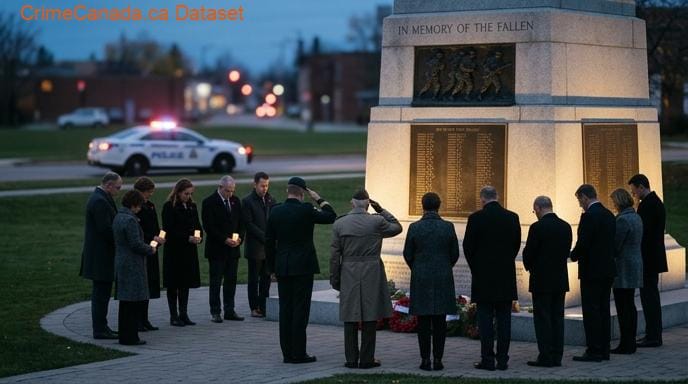
Mischief relating to war memorialshybrid offence under the Criminal Code and reported under UCR Code 2177, this charge allows the Crown to proceed either by indictment or by summary conviction, depending on the seriousness of the conduct. Because of the symbolic and emotional importance of these sites, mischief relating to war memorials is treated more seriously than ordinary vandalism, and courts often emphasize respect for national heritage and the sacrifices of veterans when sentencing. The focus keyword for this offence is mischief war memorials Canada, reflecting both the type of conduct involved and its unique place in Canadian criminal law.
The Legal Definition
Everyone who commits mischief in relation to property that is a building, structure or part thereof that primarily serves as a monument to honour persons who were killed or died as a consequence of a war, including a war memorial or cenotaph, or an object associated with honouring or remembering those persons that is located in or on the grounds of such a building or structure, or a cemetery.
This definition comes from section 430(4.11) of the Criminal Code of Canada, which is part of the broader mischief provisions found in section 430. In simple terms, a person commits this offence when they intentionally damage, destroy, deface, interfere with, or otherwise commit mischief against property that serves primarily as a war memorial or place of remembrance for people killed or who died as a result of war. This includes not only the main structure (such as a cenotaph or monument), but also related objects placed on or around it, and cemeteries dedicated to war dead. The full text and context can be reviewed on the Department of Justice website at: Criminal Code, section 430.
To understand the definition in plain English, it helps to connect it to the general concept of mischief under section 430. General mischief involves willfully destroying or damaging property, rendering it dangerous, useless, inoperative, or ineffective, or obstructing, interrupting, or interfering with the lawful use, enjoyment, or operation of property. Section 430(4.11) does not reinvent that concept; instead, it narrows the focus to a particular type of property: buildings, structures, or parts of structures that primarily function as monuments to the war dead, as well as related objects and cemeteries. The law recognizes that these locations hold cultural, historical, and emotional significance far beyond their physical value. As a result, conduct that might otherwise be charged as ordinary vandalism can be prosecuted under this more specific and symbolically weighty provision.
Penalties & Sentencing Framework
- Type of offence: Hybrid (can be prosecuted by indictment or by summary conviction).
- Mandatory minimum penalty: None explicitly stated in section 430(4.11).
- Maximum penalty (summary conviction): Up to 2 years less a day of imprisonment.
- Maximum penalty (indictment): Up to 10 years of imprisonment, consistent with general mischief maximums under section 430.
Because mischief relating to war memorials is a hybrid offence, the Crown prosecutor decides whether to proceed by summary conviction (generally reserved for less serious cases) or by indictment (for more serious or aggravated misconduct). This choice is influenced by factors such as the extent of damage, the offender’s prior record, the presence of hateful or shocking messaging, and the impact on the community. Once the mode of proceeding is chosen, the applicable maximum sentence is set: up to 2 years less a day on summary conviction, or up to 10 years on indictment, in line with the broader mischief framework in section 430 of the Criminal Code.
There is no mandatory minimum sentence expressly written into section 430(4.11) as enacted. Earlier legislative proposals (such as Bill C-217) discussed specific minimums—like a $1,000 fine for a first offence and short mandatory jail terms for repeat offences—but the final text of section 430(4.11) does not clearly establish mandatory minimum penalties. This leaves sentencing judges with considerable discretion to tailor the sentence to the circumstances of each case, while still recognizing the gravity of defacing or damaging war memorials.
In practice, sentencing for mischief war memorials Canada focuses on several key principles: denunciation, deterrence, and respect for the dignity of veterans and the memory of the fallen. Courts are likely to treat such conduct as more serious than damage to ordinary property of similar monetary value. Even where jail is not imposed—such as for a first-time offender with minor damage—judges may consider fines, probation conditions (like community service or attendance at educational programs), and restitution orders requiring the offender to pay for repairs or cleaning. For more serious or deliberate acts, especially ones tied to hateful messaging or repeated behaviour, short periods of incarceration can be imposed even where the statutory maximum is not approached.
Common Defenses
-
Lawful excuse (e.g., consent or legal authority)
Under section 429(2) of the Criminal Code, a person is not criminally responsible for mischief if they act with a colour of right or have a lawful excuse, such as consent from the person with authority over the property or a legal power to act. In the context of mischief relating to war memorials, this defence could apply if, for example, a municipality or veterans’ organization authorized alterations, cleaning, relocation, or removal of parts of a memorial, and the person carried out those instructions in good faith. Similarly, construction workers, conservators, or groundskeepers who incidentally damage a monument while performing authorized work may not be criminally liable if they acted reasonably and within the scope of their authority. The burden is on the accused to raise an air of reality to the claim of lawful excuse, after which the Crown must prove beyond a reasonable doubt that no such excuse existed.
-
Lack of intent to commit mischief
Mischief is generally a mens rea (intent-based) offence. The Crown must show that the accused acted willfully—meaning intentionally or recklessly—with respect to causing damage, interference, or disruption to the property. Accidental damage, such as unintentionally backing a vehicle into a cenotaph or inadvertent contact during a lawful ceremony, typically does not meet the mental element required for conviction. In defending against a charge under section 430(4.11), an accused may argue that they did not intend to cause damage or interference and that any harm was a genuine accident, mistake, or misunderstanding. Evidence such as the circumstances of the incident, the accused’s behaviour before and after, and corroborating witness testimony can be crucial in establishing that the necessary intent for mischief was absent.
-
Charter rights violations (e.g., s. 2(b) freedom of expression for political protests)
Some incidents involving war memorials occur in the context of political protest or expressive activity. Section 2(b) of the Canadian Charter of Rights and Freedoms guarantees freedom of expression, and accused persons may argue that their conduct—such as displaying signs, placing symbolic objects, or even writing messages—was political expression deserving constitutional protection. However, Canadian courts draw a distinction between expression and property damage. While peaceful protest near a war memorial may be protected, physically defacing, damaging, or rendering the memorial unusable can still be prosecuted as mischief, even if the message is political. Charter-based defences in this context therefore tend to focus on whether the police investigation or arrest breached other rights (such as unreasonable search and seizure under s. 8 or arbitrary detention under s. 9), or whether the law, as applied, unjustifiably limits expression. If a court finds that evidence was obtained through a Charter breach, it may be excluded under section 24(2), potentially weakening the Crown’s case. Still, the courts have generally upheld reasonable limits on expression where it involves criminal damage to highly symbolic property like war memorials.
Real-World Example
Imagine a group of individuals gathering late at night at a city cenotaph and spray-painting large political slogans across the stone surface, arguing that they are protesting a government policy. Under Canadian law, this conduct would likely constitute mischief in relation to a war memorial under section 430(4.11). Police called to the scene would consider whether the cenotaph is a structure that primarily serves as a monument to honour persons killed or who died as a consequence of war—which it clearly is. The use of spray paint to deface the monument would be seen as damage or interference with the property’s normal, respectful use. Prosecutors might proceed by indictment if the damage is extensive, the messaging is particularly shocking to the community, or the offenders have prior related records. While the individuals might argue that they were exercising freedom of expression, a court would likely find that the method they chose—permanent or semi-permanent defacement—crosses the line into criminal mischief, even if their underlying political views are protected. Sentencing could involve a combination of fines, restitution for cleaning and restoration, probation conditions limiting access to certain sites, and, in serious cases, a short custodial sentence to denounce the conduct and deter similar acts.
Record Suspensions (Pardons)
Because mischief relating to war memorials is a hybrid offence, it is treated as either a summary or indictable offence depending on how the Crown proceeds and the sentence imposed. Eligibility for a record suspension (formerly called a pardon) is governed by the Criminal Records Act and administered by the Parole Board of Canada. In general, hybrid offences are treated as indictable for record suspension purposes, which means longer waiting periods apply after the sentence is fully completed (including any probation and payment of fines or restitution). While specific timelines can change with legislative amendments, applicants typically must remain crime-free during the waiting period and demonstrate that they have complied with all court orders. The fact that the offence involves a war memorial may be considered by authorities and by potential employers or organizations reviewing a criminal record, making a record suspension particularly important for long-term rehabilitation. Anyone convicted of mischief war memorials Canada should obtain up-to-date advice on current waiting periods and application requirements before seeking a record suspension.
Related Violations
- Mischief to Cultural Property
- Vandalism (various mischief provisions under section 430)
- Public Mischief (making false reports or misleading police)