


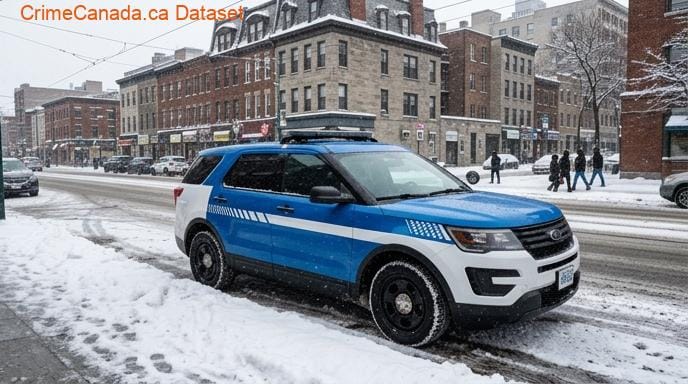
Stabbing on Masson Street in Rosemont–La Petite-Patrie Renews Focus on Evening Pedestrian Safety
A 49-year-old man is recovering in hospital after being stabbed on a sidewalk along Masson Street near 12th Avenue in Rosemont–La Petite-Patrie, Montreal. The incident occurred around 6:30 p.m. on Friday evening and left the victim with serious upper-body injuries that authorities have described as not life-threatening.
According to information attributed to the Service de police de la Ville de Montréal (SPVM), the victim reported that an altercation with another man escalated into a stabbing on the public sidewalk. The suspect fled the area before officers arrived and, based on the latest available open-source checks, was still being sought by police as of Saturday morning. No suspect description, motive, or victim identity has been formally released, and there have been no public updates on any arrest or charges.
Community Context & Social Sentiment
Rosemont–La Petite-Patrie is a mixed residential and commercial sector where streets like Masson Street are typically busy with pedestrians, small businesses, and transit users, especially in the early evening. An incident of visible violence on a sidewalk in this setting can heighten concern among residents, even when police characterize it as an isolated confrontation rather than a random attack.
Open-source scans of community discussions on major platforms (including Reddit and X) did not reveal significant public commentary specific to this event. No widely shared eyewitness accounts, videos, or neighbourhood safety debates were identified in the monitored threads and hashtags related to Rosemont–La Petite-Patrie or the SPVM. The limited online footprint suggests that while the stabbing is serious, it has not yet triggered a large-scale social media reaction or organized safety campaign.
From a broader safety perspective, this stretch of Masson Street is not widely documented in recent open data as a high-frequency violent crime hotspot. In the last year of publicly accessible mapping, no recurring pattern of stabbings at this specific intersection surfaced. This contrasts with more chronic problem areas seen in certain larger Canadian cities, where concentrated violent crime has led to sustained community pressure and policy responses.
Across Quebec, smaller municipalities often record substantially lower volumes of violent crime than dense urban neighbourhoods. For example, communities such as Saint-Alphonse-Rodriguez crime and safety data or Sainte-Rose-du-Nord crime statistics typically show fewer police-reported violent incidents per year due to lower population and different local dynamics. While those communities are not directly comparable to a central Montreal borough, they illustrate the wide variation in risk profiles across the province.
Residents in urban districts like Rosemont–La Petite-Patrie commonly express concerns around evening visibility, lighting, and the presence of witnesses when altercations occur on sidewalks. Standard personal safety practices—walking with others when possible, being attentive to escalating disputes, and promptly contacting emergency services (9-1-1) when violence is observed—remain relevant in this context.
What We Know About the Investigation
Following the stabbing, the victim was transported to hospital for treatment of serious but non-life-threatening injuries to his upper body. Investigators intend to formally interview him once his medical condition permits a complete statement. That interview will likely be central to clarifying the sequence of events, whether the parties knew each other, and what triggered the dispute.
The SPVM has opened an active investigation. Officers are reported to be canvassing the area for witnesses and examining surveillance camera footage from nearby businesses and residences. This type of video review is standard in urban assaults and can help determine whether the event was targeted, how the suspect left the scene, and whether any vehicle or accomplice was involved.
At this time, there is no confirmed public indication that the attack was random, linked to organized crime, or connected to other recent incidents. In the absence of evidence of a pattern, law enforcement and public safety analysts tend to classify such events as isolated, dispute-driven violence. Nonetheless, until a suspect is identified and arrested, residents in the immediate area may experience increased anxiety about walking alone, particularly in the early evening hours when foot traffic is still steady but businesses may be winding down.
How This Incident Fits Broader Crime Trends
Reliable, up-to-date Montreal-specific stabbing statistics were not retrieved in the open-source scan for this brief. However, data from other large Canadian cities provide useful context for understanding where a case like this sits within wider crime patterns. In Toronto, for example, recent publicly discussed police data and analyses indicate that recorded stabbing incidents had declined by roughly 45% year-over-year in early 2025 (22 down to 12 incidents for a comparable period), while overall assaults remained the most common category of violent crime.
Those Toronto figures—drawn from police dashboards and secondary analyses—also show that assault offences make up more than half of major crimes and have reached historically high absolute counts, even when homicides trend downward. Nationally, urban Crime Severity Index (CSI) values remain moderate; Toronto’s CSI has been reported below the Canadian average (around 59.4 vs. a national 79.2), indicating that large cities can experience high volumes of assaults without necessarily having extreme overall crime severity compared to the rest of the country.
Although Montreal’s exact positioning on the same indicators differs, the general pattern is instructive: non-fatal assaults and confrontations that escalate to weapons use, including knives, account for a substantial share of urban violence. The Masson Street stabbing appears consistent with this broader trend of interpersonal disputes turning into serious but survivable incidents rather than contributing to the homicide rate.
Within Quebec, more rural or remote municipalities such as Rapide-Danseur crime statistics and safety indicators or Mont-Saint-Pierre and Pointe-Lebel (see their respective crime profiles) normally report far fewer assaults simply due to population size and density. Rosemont–La Petite-Patrie, by contrast, is a dense borough within a major metropolitan area, where a higher baseline of reported incidents is expected. The key question for community safety is not whether events occur at all, but whether they cluster in specific micro-locations or show signs of escalation over time. Based on the current open-source review, no such pattern is clearly visible at the precise Masson and 12th Avenue intersection.
From a prevention standpoint, this case underscores that even in areas not labeled as high-risk, interpersonal disputes in public spaces can rapidly become violent. Targeted measures—such as maintaining effective street lighting, supporting local businesses in deploying exterior cameras, and encouraging prompt reporting of escalating conflicts—can help reduce both the likelihood and the severity of similar incidents.
About This Report
This safety alert was generated by aggregating data from local authorities, community reports, and open-source intelligence. Our mission at Crime Canada is to provide citizens with localized safety data and context. We are not the original creators of the underlying news reports.
Primary Source: Information in this report was initially covered by News Staff for CityNews.
Additional Research & Context
- Toronto Police Service open data and dashboards, as discussed in Toronto Police Service public analytics, provide comparative insight into stabbing and assault trends in another large Canadian city.
- Independent analysis of Toronto crime rates, including assaults and homicides, is summarized in legal and security sector reviews such as the Krusel Law 2025 Toronto crime statistics overview.
- Broader discussions of urban crime and neighbourhood risk patterns can be found in security industry resources like Protection Plus crime statistics commentary, which place local incidents within national trends.