


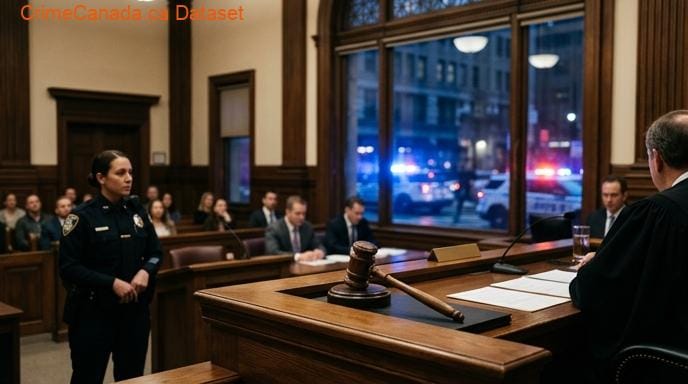
In Canada, shoplifting over $5,0002133) refers to stealing merchandise from a retail store where the total value of the goods exceeds $5,000. It is prosecuted under the general theft provision in section 334(a) of the Criminal Code. Because the value is above $5,000, this offence is treated as a more serious form of theft and is classified as a hybrid offence, meaning the Crown can choose to proceed either by indictment (more serious) or by summary conviction (less serious). When people refer to “shoplifting over 5000 Canada,” they are talking about this specific form of theft from retail premises involving high‑value goods.
The Legal Definition
“Every one commits theft who fraudulently takes or converts… anything, whether animate or inanimate with intent to deprive, temporarily or absolutely, the owner of it… (a) if the property stolen is a testamentary instrument or the value of what is stolen is more than $5,000, is guilty of (i) an indictable offence and liable to imprisonment for a term not exceeding ten years, or (ii) an offence punishable on summary conviction.”
This wording from Criminal Code, s. 334(a) is the legal foundation for theft over $5,000, which includes shoplifting from a store when the value of the items taken exceeds $5,000. The key ideas are: a fraudulent taking or conversion, something that can be owned (property), and an intent to deprive the owner of that property, either temporarily or permanently.
In plain English, shoplifting over $5,000 happens when a person, without permission, deliberately takes merchandise from a store—such as high‑end electronics, designer clothing, or luxury goods—knowing they do not have the right to take it, and intending that the store lose possession or benefit of those items. The law does not require that the deprivation be permanent; even an intention to keep or use the goods for a while, or to dispose of them and later return them, can meet the legal test if the conduct is dishonest. Because the value is greater than $5,000, the offence falls into the more serious category defined by section 334(a), as opposed to theft under $5,000 which is covered by section 334(b).
Penalties & Sentencing Framework
- Mandatory minimum penalty: None.
- Maximum penalty (indictable): Up to 10 years imprisonment.
- Maximum penalty (summary): Up to 2 years imprisonment, or a fine of up to $5,000, or both.
- Offence classification: Hybrid (can be prosecuted as indictable or summary).
Because shoplifting over $5,000 in Canada is a hybrid offence under section 334(a), the Crown prosecutor decides whether to proceed by indictment or by summary conviction. This choice usually depends on the circumstances: the total value of the goods, whether the theft was planned or part of an organized scheme, the criminal history of the accused, and any aggravating factors such as breach of trust or repeated similar conduct. An indictable election exposes the accused to a much higher maximum sentence and generally signals that the Crown views the matter as particularly serious.
There is no mandatory minimum sentence. This means judges have significant discretion to craft a sentence that fits the offender and the offence. For first‑time offenders, especially where the goods are recovered undamaged and there are mitigating factors (such as remorse, cooperation with police, or underlying addiction issues being treated), courts may consider non‑custodial sentences, such as probation, fines, restitution orders to compensate the store, or conditional sentences (served in the community) if legally available. However, as the value and planning increase—such as repeated large‑scale thefts from multiple stores—courts more often impose jail terms to emphasize deterrence and denunciation.
On a summary conviction for shoplifting over $5,000, the maximum penalty is up to two years less a day in jail, a fine up to $5,000, or both. Summary proceedings are generally reserved for less serious cases: lower value over the threshold, quick guilty pleas, or minimal prior record. On an indictable conviction, the maximum is up to 10 years in prison. In practice, actual sentences are far below that maximum, but a conviction for theft over $5,000 is still treated as a significant property offence that can have serious immigration, employment, and travel consequences. Regardless of election, a conviction creates a permanent criminal record unless and until a record suspension (pardon) is obtained.
Common Defenses
-
Lack of intent to deprive (fraudulent mens rea not proven)
To prove shoplifting over $5,000, the Crown must show beyond a reasonable doubt that the accused intended to deprive the store of the property, at least temporarily, and that the taking was dishonest or “fraudulent.” If the accused genuinely lacked this intent—for example, they absent‑mindedly walked past the cash with expensive items in a cart while distracted, intending to pay but forgetting—the mental element (mens rea) may not be met. Evidence such as immediately returning to pay, confusion at self‑checkout, language barriers, or medical conditions affecting memory or awareness can be relevant. The defense does not succeed merely because the accused says they intended to pay; the court assesses all the surrounding circumstances (behaviour in the store, concealment of items, attempts to flee, prior incidents) to decide whether the fraudulent intent has been proven.
-
Claim of right (belief in lawful entitlement to the property)
A “claim of right” defence arises when the accused honestly believed they had a legal right to the property, even if that belief is mistaken. In the context of shoplifting over $5,000, this might occur where the person believes that the items are already theirs (for example, a dispute over a prior purchase or warranty replacement), or that they are entitled to take the goods as compensation for money the store supposedly owes them. Under the general theft provisions, an honest belief in a legal entitlement—even if unreasonable—can negate the fraudulent intent required for theft, as long as the belief is genuinely held. However, mere dissatisfaction with service or prices, or a general feeling that “the store makes lots of money so it doesn’t matter,” is not enough. The defence focuses strictly on whether the accused believed they had a legal right to those specific goods.
-
Mistaken belief in consent (reasonable belief owner consented)
This defence applies where the accused honestly believed that the owner of the store, or someone with apparent authority (such as a manager), had given them permission to take the items without payment or at a deep discount that appears like non‑payment. For instance, a person may rely on what they were told by a staff member—perhaps they were assured that certain items were free, mis‑scanned, or included in a promotion. If the accused can show that they had an honest, and typically reasonable, belief that the owner had consented to them taking the goods in the manner they did, the essential element of taking “without colour of right” or without consent may not be made out. The court looks at what was said, how clear the alleged consent was, whether the staff member actually had authority, and whether a reasonable person in the accused’s position would have believed that consent existed.
Real-World Example
Imagine someone enters a high-end electronics store and selects a premium laptop, several tablets, and accessories, with a total value exceeding $5,000. They remove the security tags, place the items into a large bag, and walk past all points of sale without attempting to pay. Store security observes the conduct on surveillance cameras and detains the person outside the store, then calls the police. In this scenario, the behaviour—concealing expensive items, bypassing the cash, and attempting to leave—is strong evidence of a fraudulent intent to deprive the store of its property. Because the value of the goods is over $5,000, the person would likely be charged under section 334(a) with theft over $5,000, coded as UCR 2133 for shoplifting. The Crown may elect to proceed by indictment if, for example, the accused has a record for similar offences or if there is evidence of an organized retail theft scheme. At trial, defenses like lack of intent or claim of right would be difficult to sustain on these facts, though the accused could still seek a reduced sentence by pleading guilty early, offering restitution, and showing rehabilitation.
Record Suspensions (Pardons)
A conviction for shoplifting over $5,000 in Canada results in a permanent criminal record unless a record suspension (commonly known as a pardon) is obtained through the Parole Board of Canada. Because this is a hybrid offence, the waiting period depends on how the Crown proceeded and how the sentence was structured. Where the matter is treated as an indictable offence, the current waiting period before applying for a record suspension is typically 5 years after completion of the entire sentence (including jail, probation, and payment of any fines or restitution). If the Crown proceeds by summary conviction, the waiting period is generally 3 years after the sentence is fully completed. During this time the individual must remain crime‑free. A record suspension, if granted, does not erase the conviction but separates it from other criminal records and can significantly improve access to employment, housing, and travel. Because theft over $5,000 is considered a serious property crime, strong evidence of rehabilitation, stable lifestyle, and payment of restitution will be important in any application.
Related Violations
- Theft under $5,000
- Fraud over $5,000
- Possession of Stolen Property
For anyone facing allegations of shoplifting over 5000 Canada, it is crucial to understand how section 334(a) operates, how value thresholds affect the seriousness of the charge, and how intent, consent, and claim of right can shape both liability and potential defenses.