


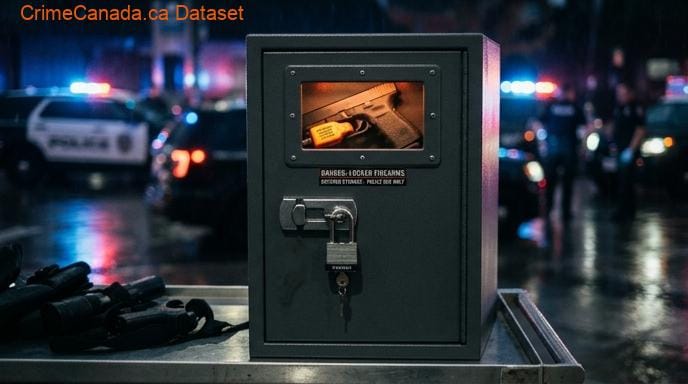
Unsafe storage of firearms is a criminal offence in Canada that targets the careless storage, handling, transportation, and display of guns and related weapons. Classified as a hybrid offence under the Criminal Code, it can be prosecuted either summarily or by indictment depending on the seriousness of the circumstances. Under the Uniform Crime Reporting system it is coded as UCR Code 3395. In practical terms, unsafe storage firearms Canada cases usually involve situations where a firearm is left accessible, not properly locked or secured, or handled in a way that creates a real risk to people or property.
The Legal Definition
Criminal Code, Section 86(1): Every person commits an offence who, without lawful excuse, uses, carries, handles, ships, transports or stores a firearm, a prohibited weapon, a restricted weapon, a prohibited device or any ammunition or prohibited ammunition in a careless manner or without reasonable precautions for the safety of other persons.
Section 86(2): Every person commits an offence who contravenes a regulation made under paragraph 117(h) of the Firearms Act respecting the storage, handling, transportation, shipping, display, advertising and mail-order sales of firearms and restricted weapons.
In plain English, section 86 makes it a crime to deal with firearms and certain other weapons in a way that is careless or fails to take reasonable safety precautions. This applies not just to where and how a firearm is stored, but also to how it is used, carried, transported, shipped, displayed, or advertised. A person can be charged under subsection 86(1) for generally careless conduct, or under subsection 86(2) for breaching specific storage and handling rules found in the regulations under the Firearms Act. The official wording can be found in full on the Department of Justice website at section 86 of the Criminal Code.
The phrase “without lawful excuse” means the law recognizes some narrow situations where conduct that might otherwise look unsafe is legally allowed, usually because it falls within specific regulatory exceptions. The wording “careless manner” and “without reasonable precautions” focuses the offence on real-world risk: the Crown must connect the way the firearm was stored or handled with a meaningful risk to people or property. It is not enough that the police or Crown simply disapprove of how the firearm was kept; they must show that it was objectively unsafe when judged against what a reasonable firearms owner would do in the same circumstances.
Penalties & Sentencing Framework
- Type of offence: Hybrid (can proceed summarily or by indictment).
- Mandatory minimum penalty: None.
- Summary conviction (first or subsequent offences): Up to 2 years less a day imprisonment and/or a fine.
- Indictable conviction – first offence: Up to 2 years imprisonment.
- Indictable conviction – subsequent offences: Up to 5 years imprisonment.
Because unsafe storage of firearms is a hybrid offence, the Crown prosecutor chooses whether to proceed by summary conviction or by indictment. That decision usually depends on factors such as whether the firearm was loaded, whether children or vulnerable persons were present, whether the conduct was repeated, and whether any injury, property damage, or other criminal conduct was involved. Summary proceedings are typically reserved for less serious or first-time incidents; indictable proceedings are used when the circumstances are aggravated or there is a pattern of unsafe behaviour.
There is no mandatory minimum sentence for unsafe storage. This gives sentencing judges flexibility to match the penalty to the circumstances of the offence and the offender. For relatively minor, first-time cases where no one was harmed and the risk was low, sentences may consist of fines, probation, firearms prohibition orders, or a combination of these. For more serious cases—such as repeated unsafe storage, clear disregard of the regulations, or situations where someone was injured or there was a near miss—courts may impose jail terms, particularly when the Crown has proceeded by indictment and the offender has prior firearms-related convictions.
For indictable convictions, the maximum is up to 2 years imprisonment on a first offence and up to 5 years where the accused has prior indictable convictions for similar conduct. These are ceiling penalties, not starting points. Sentencing courts consider the fundamental purpose of sentencing in Canada: denunciation of unlawful conduct, deterrence of the offender and others, protection of the public, rehabilitation, and promoting a sense of responsibility. In unsafe storage firearms Canada cases, courts often stress public safety and general deterrence, emphasizing the trust placed in licensed firearm owners to strictly follow storage and handling rules.
Common Defenses
-
Lawful excuse (including regulatory exceptions, such as predator control)
Section 86 explicitly refers to conduct “without lawful excuse.” One recognized route to a lawful excuse is compliance with specific exceptions set out in regulations under the Firearms Act. For example, certain provincial or federal guidelines and regulations permit temporary relaxed storage where a firearm is in active use, such as during predator control on a farm or while lawfully hunting, provided other safety conditions are met. If the accused can show that their conduct fell squarely within one of these regulatory exceptions—such as a firearm kept temporarily accessible for immediate use against predators in accordance with the applicable regulation—that may constitute a lawful excuse. The defense does not give a blanket licence to ignore safety; it is tightly tied to what the regulations actually allow. The accused normally bears an evidentiary burden to raise this issue, after which the Crown must show beyond a reasonable doubt that no lawful excuse applied.
-
No carelessness proven (no real risk to persons or property)
Another key defense focuses on the Crown’s obligation to prove carelessness or the absence of reasonable precautions. It is not an offence merely to depart slightly from ideal practice; the conduct must be objectively careless or lacking reasonable safety measures. Courts often look at factors such as whether the firearm was loaded, whether ammunition was stored separately, whether children or others had realistic access, and whether theft or misuse was a foreseeable risk. If the firearm was, for example, unloaded, disabled, stored in a secluded and controlled location, and effectively inaccessible to unauthorized persons, the defence may argue that there was no meaningful risk created, and therefore no carelessness within the meaning of section 86. If a reasonable person in the same situation would have considered the measures adequate, the Crown may fail to meet its burden of proof.
-
Reasonable precautions taken (secure locking or inoperability)
Section 86 measures conduct against what constitutes “reasonable precautions for the safety of other persons.” The regulations under the Firearms Act set out concrete examples of what is considered reasonable, such as storing non-restricted firearms unloaded and either locked with a tamper-resistant device (like a trigger lock or cable lock) or locked inside a container, room, or safe that is constructed so it cannot easily be broken into. For restricted and prohibited firearms, the requirements are stricter but follow the same logic of locked, unloaded, and secured storage. If the accused can demonstrate that they followed these regulatory standards—such as by showing the presence and proper use of a locking device, or that the firearm was stored in a sturdy locked safe—this can support a defence that they did, in fact, take reasonable precautions. The court will examine whether the measures were real and effective, not merely cosmetic. But robust compliance with the regulations is powerful evidence against a finding of unsafe storage.
Real-World Example
Consider a homeowner who owns a validly registered hunting rifle. After returning from a hunting trip, they leave the rifle, still unloaded but without any locking device, on a table in the living room of a house where young children live. Ammunition is stored separately but within the same home. A visiting relative notices the firearm, becomes concerned, and contacts the police. When officers attend, they find the rifle easily accessible to any person walking through the house, including the children.
In this scenario, the police could reasonably allege unsafe storage of firearms under section 86. Although the rifle is unloaded, it is not locked, not kept in a secure container or safe, and is plainly accessible in a household with children. This creates a clear risk that a child or other unauthorized person could handle the firearm, potentially load it if they find ammunition, or cause injury or damage. The Crown would likely argue that the homeowner failed to take “reasonable precautions” as required by the Criminal Code and related regulations. Unless the homeowner could point to a lawful excuse (such as an applicable and properly followed regulatory exception) or demonstrate that they had in fact complied with the regulatory storage requirements, a conviction is possible. The court would then consider factors like the degree of risk to the children, the length of time the firearm was left out, and the homeowner’s overall record to decide on an appropriate sentence.
Record Suspensions (Pardons)
Because unsafe storage of firearms is a criminal offence under the Criminal Code, a conviction will create a criminal record that can affect employment, travel, and the ability to own or possess firearms in the future. A record suspension (commonly called a pardon) does not erase the conviction, but it sets it aside in the Canadian Police Information Centre (CPIC) database so that it is not disclosed in most criminal record checks.
For unsafe storage firearms Canada convictions, record suspension eligibility depends on how the offence was prosecuted and the sentence imposed. Broadly speaking, if the offence was prosecuted by summary conviction, the current waiting period is typically 5 years after the individual has completed all parts of their sentence, including any jail time, probation, and payment of fines or surcharges. If the offence was prosecuted by indictment, the general waiting period is typically 10 years from sentence completion. During that waiting period, the individual must remain crime-free and demonstrate good conduct; any new criminal charges or convictions can delay or jeopardize an application. Because firearms offences can also lead to firearms prohibition orders, a person seeking to fully restore their status as a firearms owner should obtain legal advice about how a record suspension interacts with any existing or potential prohibitions.
Related Violations
- Careless Use of a Firearm
- Unauthorized Possession of a Firearm
- Possession of a Weapon for a Dangerous Purpose