
Table of Contents
Abbotsford Highway 1 Encampment Homicide Sparks Renewed Safety Fears and Calls for Provincial Action
Section 1: What Happened & Current Safety Outlook
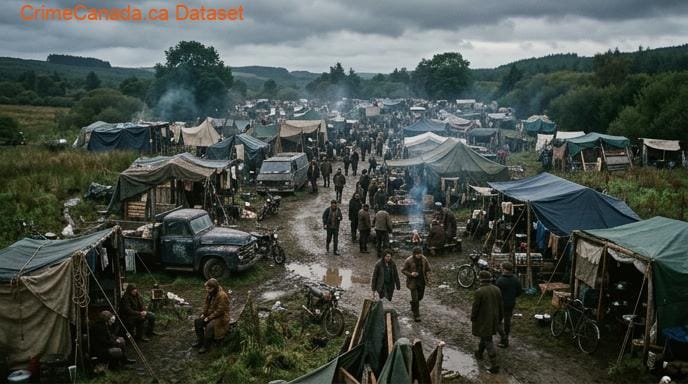
A targeted shooting that killed a 69-year-old man and a separate major fire at an encampment beside Highway 1 in Abbotsford, British Columbia have intensified scrutiny of long-standing safety issues at the Whatcom Road Park & Ride. The homicide occurred on March 24, 2026, at the provincially owned rest area, where tents, RVs, and makeshift shelters have accumulated over more than two years. The victim has been identified as Wayne Versfelt, 69. Investigators with the Integrated Homicide Investigation Team (IHIT) describe the shooting as targeted and continue to seek witnesses.
Days later, a significant fire broke out in the same encampment area, further highlighting ongoing concerns about fire risk, mental health crises, and criminal activity near the highway corridor. According to the Abbotsford Police Department (AbbyPD), officers have responded to more than 200 calls for service in the immediate vicinity over the past year, despite the land falling under provincial rather than municipal control. On March 26, police executed a search warrant at the Park & Ride as part of the homicide investigation. As of March 28, 2026, no arrests or suspects have been publicly named, and IHIT has not announced any major investigative breakthroughs.
Section 2: Community Context & Social Sentiment
The Whatcom Road encampment has become a focal point for frustration in Abbotsford, where residents, truck drivers, and nearby businesses have repeatedly flagged the site as unsafe and unsanitary. Online commentary describes overflowing garbage, sewage issues, and blocked access for commercial truckers who rely on the rest stop. Some local voices argue that the location has become an unofficial camp where vulnerable people are left in dangerous conditions while opportunistic offenders exploit them.
At the same time, there is a clear thread of sympathy for people living at the encampment. Residents and outreach workers point to a rapidly growing homeless population, mental health challenges, and substance use as underlying drivers rather than simple lawlessness. One anonymous encampment resident has reportedly linked the fatal shooting to a dispute over gas money for a shared generator, and suggested that the later fire may have involved a person in acute mental distress. These accounts emphasize the complex mix of poverty, trauma, and criminal exploitation that shapes daily life in the camp.

Local officials are publicly pressing the province to step in. In a recent statement, Abbotsford Mayor Ross Siemens noted that the city has repeatedly raised concerns with the Ministry of Transportation and Transit about conditions at Whatcom Road and the need for sustained action on provincially managed lands. AbbyPD spokesperson Sgt. Paul Walker has also stressed that, while officers continue to respond to calls, meaningful change depends on direction and cooperation from the landowner—in this case, the province—whether that means cleanup operations, security measures, or coordinated social supports.
The province, through the BC Ministry of Transportation, has indicated that it is actively dismantling another nearby encampment at Cole Road and plans to turn its attention to Whatcom Road next, although no detailed timeline has been released. Many Abbotsford residents worry that without additional housing, shelter capacity, and mental health services, the issue will simply shift along the highway corridor rather than be resolved—what some describe as a “Whack-a-Mole” pattern of dispersing encampments without addressing root causes.
For residents tracking local risk, broader crime trends in the area can be explored through regional data such as the Abbotsford, British Columbia — Crime Statistics & Safety Data and the wider Abbotsford-Mission Crime Statistics & Safety Report, which provide context on how encampment-related incidents fit into citywide patterns of violence, property crime, and public disorder.
Section 3: Statistical Overview & Broader Safety Trends
While precise citywide figures specific to encampments are not currently available in public datasets, several indicators frame the Whatcom Road situation within larger trends. AbbyPD has logged more than 200 calls for service to the Park & Ride area in the last year, covering a spectrum of issues that typically include disturbances, suspected drug activity, welfare checks, and fires. For a single rest area, that call volume suggests a significant concentration of police resources and elevated risk compared with most roadside facilities.
Encampments along Highway 1 near Abbotsford—including Whatcom Road and other rest stops such as Cole Road and Bradner—have been present for more than two years. Over that period, reports have highlighted recurring problems: tents and RVs situated close to high-speed traffic, thefts and conflicts within the camps, open burning and accidental fires, and infrastructure impacts such as blocked parking for commercial drivers and degraded washroom facilities. These factors create overlapping safety concerns for unhoused residents, passing motorists, and nearby communities.
Province-wide, many municipalities are dealing with similar tensions between public safety, transportation infrastructure, and homelessness. Regional crime data for jurisdictions surrounding Abbotsford, such as Fraser Valley A, British Columbia — Crime Statistics & Safety Data, show that rural and highway-adjacent areas can experience concentrated issues related to property crime, disorder, and emergency health calls when services are limited and people settle in informal camps.
In this context, the homicide of Wayne Versfelt and the subsequent fire do not appear as isolated anomalies but as acute flashpoints in an already strained environment. The lack of a named suspect and the ongoing nature of the investigation mean that specific motives and affiliations remain unconfirmed. However, both police commentary and on-the-ground accounts suggest a pattern where vulnerable individuals living in the encampment are at heightened risk of being victimized by more entrenched criminal actors who move through or embed themselves in the camp.
From a community safety perspective, the main risk factors now identified around the Whatcom Road encampment include:
- High frequency of police calls and documented violent incidents (including at least one homicide and multiple fires).
- Physical hazards linked to makeshift housing and open flames in close proximity to Highway 1 traffic and fuel sources.
- Limited clarity over jurisdiction and responsibility between municipal authorities and the provincial landowner, which can delay coordinated action.
- Insufficient shelter, housing, and mental health supports, increasing the likelihood that displaced residents will relocate to other informal sites rather than enter safer, managed environments.
Residents who live, work, or travel near Whatcom Road should be aware that law enforcement remains active in the area while the homicide investigation continues. Authorities are encouraging anyone with dashcam footage, eyewitness accounts, or other information related to the March 24 shooting or subsequent fire to contact IHIT or local police. At the same time, longer-term risk reduction will depend on provincial and municipal collaboration to provide safer alternatives to roadside encampments, alongside enforcement focused on individuals who exploit or endanger people living in these camps.
About This Report
This safety alert was generated by aggregating data from local authorities, community reports, and open-source intelligence. Our mission at Crime Canada is to provide citizens with localized safety data and context. We are not the original creators of the underlying news reports.
Primary Source: Information in this report was initially covered by Emma Crawford for CityNews.
Additional Research & Context
- Further details on the victim identification and IHIT’s ongoing investigation into the March 24 shooting at Whatcom Road are summarized in CityNews coverage of the homicide victim and initial response: IHIT identifies victim in Abbotsford encampment shooting and initial report on the fatal shooting.
- A 2025 analysis of the Whatcom Road homeless encampment outlines the site’s history, resident complaints, and debates over which level of government is responsible for managing conditions at the Highway 1 rest stop.
- For broader context on provincial actions at similar sites, a Global News report on nearby Highway 1 rest stop encampments details Ministry of Transportation plans to clear encampments, including Cole Road, and the implications for displaced residents.