
Table of Contents
Before cannabis was legalized in Canada on October 17, 2018, cannabis production pre-legalization was a serious drug offence governed by the federal Controlled Drugs and Substances Act (CDSA), not the Criminal Code itself. Under Uniform Crime Reporting (UCR) Code 4440, police and courts recorded cases where a person illegally produced cannabis, such as growing plants or operating an unlicensed grow operation. This was a hybrid offence, meaning the Crown could choose to proceed by summary conviction for less serious cases or by indictment for more serious, large‑scale or commercial production. The legal framework aimed to tightly control who could produce cannabis and under what conditions, with potentially severe penalties for unauthorized production.
The Legal Definition
“Except as authorized under the regulations, no person shall produce or attempt to produce a substance included in Schedule I, II, III or IV.”
(Controlled Drugs and Substances Act, s. 7(1))
Under the CDSA, cannabis was listed in Schedule II, so this broad prohibition directly covered cannabis production pre-legalization. In simple terms, it was a crime to produce or try to produce cannabis in any way unless a person was specifically allowed to do so under the regulations—typically through a medical or research authorization. “Produce” was interpreted broadly and included growing, cultivating, propagating, manufacturing, or synthesizing the substance, whether the operation was a small home grow or a large commercial greenhouse.
The phrase “except as authorized under the regulations” is crucial. The CDSA and its regulations created narrow pathways for lawful cannabis production, for example, for medical cannabis producers or scientific researchers. Anyone outside these authorization schemes who grew or manufactured cannabis was committing an offence. Because the offence appears in federal legislation, it applied across Canada uniformly. The full statutory context can be reviewed in the Controlled Drugs and Substances Act, which sets out not only the core prohibition in section 7 but also the schedules listing controlled substances and the framework for authorizations.
Penalties & Sentencing Framework
- Offence type: Hybrid (prosecutable by summary conviction or indictment)
- Mandatory minimum penalty: None
- Maximum on summary conviction: Fine of up to $1,000 or up to 6 months’ imprisonment, or both
- Maximum on indictment: Up to life imprisonment
Because cannabis production pre-legalization was a hybrid offence, the Crown had significant discretion in choosing how to proceed. For smaller, less sophisticated operations or first‑time offenders, the prosecution might elect to proceed summarily. In that situation, the maximum sentence that a judge could impose was a $1,000 fine, 6 months in jail, or both. Summary proceedings are generally reserved for less serious cases, have shorter limitation periods to commence charges, and typically result in lower sentences.

By contrast, serious cannabis production cases—especially those involving large-scale grow operations, commercial distribution, links to organized crime, or significant public safety risks—were often prosecuted by indictment. On indictment, the maximum penalty for unauthorized production of a Schedule II substance such as cannabis was life imprisonment. In practice, courts reserved very lengthy custodial sentences for the most aggravated cases (for example, massive industrial grow operations, repeated offending, or situations with aggravating factors such as traps, firearms, or environmental damage). However, the life‑maximum underlined Parliament’s view that large‑scale illegal drug production was a grave threat to public health and safety.
Importantly, there were no mandatory minimum sentences for cannabis production under the framework described here. That meant sentencing judges retained discretion to tailor the sentence to the circumstances of the offence and the offender, guided by general sentencing principles such as denunciation, deterrence, rehabilitation, and proportionality. Sentences could range from discharges, fines, and community‑based orders for minor cases, up to significant penitentiary terms for serious production operations. Factors like the number of plants, degree of sophistication, presence of children, use of stolen electricity, and any prior criminal record often influenced where a sentence would fall in that range.
Common Defenses
-
Lawful authorization or exemption under CDSA regulations
A central element of the offence is that production must be unauthorized. Where an accused person held a valid authorization, licence, or exemption under the CDSA regulations—for example, a medical cannabis production licence or a research exemption—this could form a complete defence. The defence would involve showing that, at the time of the alleged offence, the person’s production activities fell within the scope of a valid authorization and complied with its conditions (such as plant limits, security measures, and production site restrictions). If the Crown cannot disprove lawful authorization beyond a reasonable doubt, the offence is not made out. Disputes sometimes arose over whether the accused exceeded the scope of a licence (e.g., too many plants or production at an unapproved location), in which case the authorization might not shield them from liability. -
Lack of knowledge or lawful excuse
To secure a conviction, the Crown must generally prove that the accused knowingly produced or attempted to produce cannabis. A defence may arise where a person genuinely lacked the requisite knowledge or reasonably believed they had lawful authority. For example, someone who lived in a house where others secretly operated a grow operation in the basement could argue that they had no knowledge of the production. Another scenario is an honest but mistaken belief in authorization—such as relying on what appeared to be a valid licence or official advice. While ignorance of the law is not a defence, a factual mistake that negates the mental element (for instance, believing that the plants were a different lawful species, or that a licence covered a particular location) can be. A “lawful excuse” may also arise in rare, tightly defined circumstances recognized by law, but it must be grounded in demonstrable facts and not a mere disagreement with drug policy. -
Charter rights violations
Cannabis production investigations often relied on searches of homes, warehouses, or rural properties. Under section 8 of the Canadian Charter of Rights and Freedoms, everyone has the right to be secure against unreasonable search or seizure. If police entered premises, seized plants, or collected evidence without a valid warrant or proper legal authority—or exceeded the scope of a warrant—the defence may bring a Charter motion arguing that the accused’s rights were violated. If a court finds a breach, it can consider excluding the evidence under section 24(2) of the Charter. In drug cases, excluding seized cannabis plants, equipment, or incriminating statements can be fatal to the prosecution’s case. Charter arguments might also arise under section 9 (arbitrary detention), section 10 (rights on arrest or detention), or section 7 (fundamental justice) depending on the investigative methods used. The success of such defences depends on detailed factual analysis of how the investigation was conducted.
Real-World Example
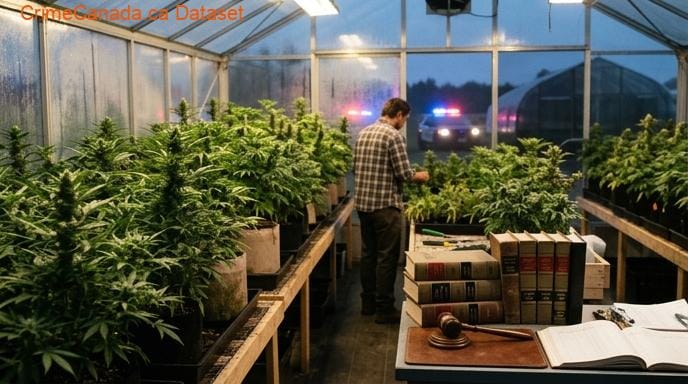
Imagine a person setting up a large-scale greenhouse to cultivate cannabis without any legal permits or medical production licenses before 2018. The greenhouse contains hundreds of plants, sophisticated lighting and irrigation, and is clearly intended to supply cannabis to a wide market, not just for personal use. Neighbours report suspicious activity and unusually high electricity consumption. Police obtain a search warrant based on this information, enter the property, and discover the operation.
Under the pre-legalization CDSA framework, this conduct squarely fits the offence of unauthorized cannabis production. The individual has clearly produced a Schedule II substance and has no authorization under the regulations. Police would seize the plants and equipment, photograph the scene, and arrest the person in charge. The Crown would likely treat this as a serious case and proceed by indictment, given the commercial scale and sophistication. At trial, the Crown would rely on evidence of the grow operation and any admissions made by the accused. The defence might challenge the validity of the search warrant (arguing a Charter breach) or claim the accused had no knowledge of the operation. If the warrant is upheld and the evidence shows the accused ran the greenhouse, the court would likely convict and impose a significant jail sentence, emphasizing deterrence and denunciation of large‑scale illegal drug production.
Record Suspensions (Pardons)
Even though cannabis has since been legalized under a different regime, a conviction for cannabis production pre-legalization remains a criminal record entry unless it is removed through a record suspension (formerly called a pardon). Eligibility and waiting periods depend on whether the offence was dealt with summarily or by indictment. For a summary conviction under the CDSA, the waiting period before applying for a record suspension is typically shorter. For an indictable conviction, the waiting period is longer and the application is more closely scrutinized, particularly for serious drug offences. The Parole Board of Canada considers factors such as the nature of the offence, compliance with sentencing conditions, and subsequent conduct. While some simple cannabis possession offences have been subject to streamlined or special record relief measures, those generally do not extend in the same automatic way to production offences, which were treated as more serious in law. Individuals with an old production conviction should review the current Parole Board guidelines or consult a legal professional to determine their specific eligibility based on how their case was prosecuted.
Related Violations
- Possession for the Purpose of Trafficking
- Importing and Exporting of Cannabis
- Trafficking of Controlled Substances