
Table of Contents
Dauphin Weapons Seizure Sparks Questions About Firearms Trafficking and Rural Safety in Manitoba
Large Firearms Cache and Cash Seized in Dauphin
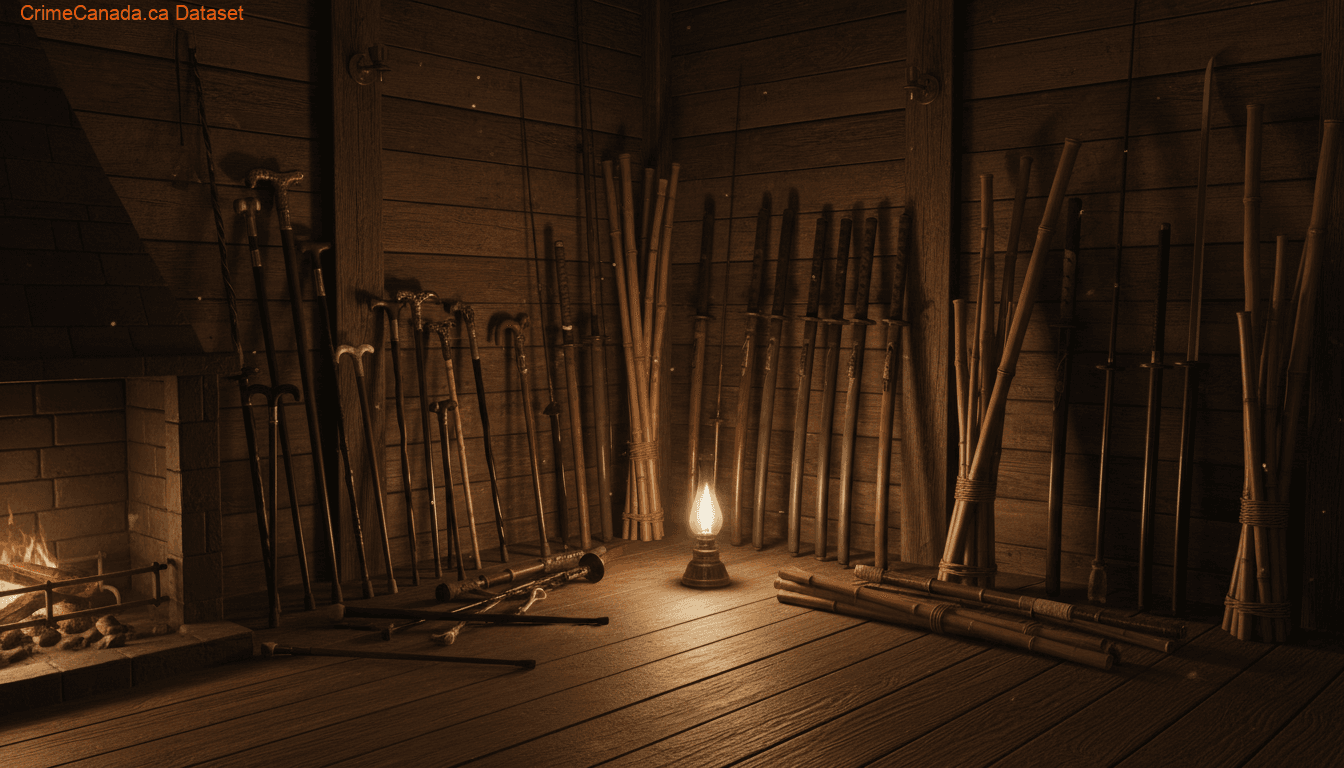
Manitoba RCMP say a months-long firearms trafficking investigation led to the search of a home in Dauphin, Manitoba on July 4, 2026, where officers reported finding an extensive weapons collection and a significant amount of cash. According to police, the search resulted in the seizure of 439 firearms, an antique cannon, and roughly $300,000 in Canadian currency.
Investigators allege that at least three of the seized firearms were involved in illegal trafficking, and that one firearm had a tampered serial number. RCMP say it will take several weeks to fully catalogue the stockpile and confirm how many of the firearms were lawfully possessed versus prohibited or improperly stored. No injuries were reported in connection with the investigation, and the case is being treated as a serious public-safety and firearms-trafficking matter rather than a violent incident.
Charges, Allegations, and Ongoing Court Process
Police have identified the accused as Inky (Inkster) Mark, 78, of Dauphin. He is charged with multiple firearms-related offences, including:
- Firearms trafficking
- Possession of a firearm with a tampered serial number
- Possession of property obtained by crime
- Unsafe storage of firearms
RCMP state that Mark was known as a firearms collector, and officers emphasize that owning a large number of guns is not in itself a crime under Canadian law. The alleged criminal conduct relates to suspected trafficking activity, the status of particular firearms, storage practices, and the origins of the seized cash. The allegations have not been proven in court, and there is currently no public information on trial dates, bail conditions, or additional charges beyond the initial counts.

This Dauphin search is linked to an earlier investigation into a 73-year-old Dauphin-area man, identified in RCMP releases as Wilfred Kachurowski, who faces separate firearms charges in the United States and in Manitoba. During a search connected to that first suspect, officers located firearms that had been purchased by a second individual and, according to police, were never lawfully transferred. That discovery led investigators to obtain a warrant for Mark’s residence, where the large cache and cannon were seized.
Community Context & Social Sentiment
The seizure has generated intense local and provincial discussion, fuelled in part by Mark’s long-standing public profile and the unusual detail of an antique cannon being removed from a private property. Online conversations in Manitoba-focused spaces on X (formerly Twitter) and Reddit reflect a mix of shock, skepticism, and concern about broader gun-control and enforcement issues.
Some residents point to this case as evidence that rural firearms collecting can blur into high-risk stockpiling and potential trafficking. One Reddit commenter, reacting to the reported total of 439 guns and a cannon, argued that such a cache goes beyond what most people would consider typical collecting and indicates gaps in oversight. On X, others focused on the cross-border element of the wider investigation, questioning how weapons apparently moved between Manitoba and the United States despite Canada’s relatively strict firearms regulations on paper.
At the same time, a significant number of comments express concern about stigmatizing lawful gun owners in rural communities. These voices stress that Canadian law does not cap the number of firearms a properly licensed person can own, and they argue that judgment should wait until the courts determine whether trafficking or unlawful possession actually occurred. This tension between fears of organized crime and defence of legitimate rural gun ownership is a recurring theme in local debate.
Dauphin itself is a small regional hub in Manitoba’s Parkland area, with a population in the range of 8,000–8,500 residents. Like many rural communities, it has a strong culture of hunting and sport shooting, which can contribute to higher rates of legal firearms ownership compared with large urban centres. Nearby communities across the province show similar patterns: for example, crime and safety data for towns such as Carman, Manitoba or smaller centres like Fisher, Manitoba illustrate how rural areas can combine low rates of certain street crimes with a relatively high presence of firearms and occasional weapons-related enforcement actions.
Local Safety Profile: Dauphin and Surrounding Area
Although this case is striking due to the scale of the seizure, it does not exist in isolation. Over the past year, Manitoba RCMP have reported a series of weapons-related investigations in and around Dauphin. Recent releases describe arrests linked to:
- Possession of prohibited firearms and carrying concealed weapons
- Weapons possession contrary to court orders
- An armed robbery at a Dauphin business allegedly involving a firearm
- Traffic stops that uncovered stolen vehicles containing guns and drugs
These incidents collectively suggest that local law enforcement is dealing with a steady workload around illicit weapons, orders prohibiting firearm possession, and associated property or drug crime. While most Dauphin residents will never directly encounter high-end trafficking investigations, the community is experiencing repeat instances in which guns, knives, or other weapons intersect with police calls.
In that context, RCMP senior leadership are emphasizing the broader risks of illegal firearms circulation. Officials have reiterated that unregistered or smuggled guns are hard to trace, can be diverted into the hands of organized crime, and may ultimately surface in robberies, assaults, or other violent incidents elsewhere in the province. A large cache discovered in one home, even if primarily tied to collecting, represents a potential source of supply if weapons are diverted or stolen.
How This Case Fits Provincial Firearms Trends
Viewed against Manitoba’s wider crime landscape, the Dauphin seizure aligns with an emerging pattern of large rural firearms recoveries. Over the past several years, RCMP have documented multiple cases where officers discovered dozens or even more than one hundred firearms in private homes outside major cities. In one earlier investigation in southwestern Manitoba, for example, police seized over 100 firearms and an operational antique cannon from a rural property, alongside allegations of unsafe storage and unauthorized possession.
These events highlight a few key provincial trends:
- Concentration of weapons in private rural residences: High-volume caches are periodically uncovered, often combined with regulatory violations such as improper storage, unregistered weapons, or prohibited devices.
- Cross-border and trafficking concerns: The link between the Dauphin case and U.S. firearms charges against an associated suspect illustrates how local investigations can connect to importation and trafficking networks that extend beyond provincial boundaries.
- Organized crime risk: RCMP messaging consistently links illegal firearms trafficking to organized crime activity and community violence, underscoring why large seizures—even where no immediate act of violence is alleged—are treated as significant public-safety interventions.
Precise incident rates per 100,000 residents for Dauphin and comparable communities are not fully available from brief police releases alone. However, the frequency of weapons-related RCMP bulletins in the Parkland region and across rural Manitoba suggests that controlling illegal firearms is an ongoing enforcement priority. Residents who wish to understand how firearms-related crime in Dauphin compares with other small centres can reference regional crime-statistics tools, such as those covering communities like Fisher River 44A, to place high-profile cases like this one in a broader statistical framework.
For now, the Dauphin seizure remains at the charge stage. Court proceedings and further RCMP forensic work on the recovered collection will determine how many of the 439 firearms and the related cash can be clearly linked to criminal offences versus lawful collecting. Until those legal questions are resolved, community discussion is likely to continue to pivot between concerns about trafficking and respect for due process.
About This Report
This safety alert was generated by aggregating data from local authorities, community reports, and open-source intelligence. Our mission at Crime Canada is to provide citizens with localized safety data and context. We are not the original creators of the underlying news reports.
Primary Source: Information in this report was initially covered by News Staff for CityNews Winnipeg.
Additional Research & Context
- Background on the linked firearms-trafficking investigation and charges against a 73-year-old Dauphin-area man is available in a detailed Manitoba RCMP news release on cross-border weapons offences.
- Recent RCMP bulletins on weapons seizures and arrests in Dauphin provide additional context on the city’s recent firearms-related enforcement activity.
- A prior case involving more than 100 firearms and a working antique cannon seized from a rural Manitoba home is summarized in coverage of a Wawanesa-area firearms investigation, illustrating that large rural weapons caches are not unique to Dauphin.