
Table of Contents
Edmonton Ravine-Area Break-Ins: What Southwest Residents Need to Know About Recent Home Burglaries
Overview: What Police Say Is Happening
The Edmonton Police Service (EPS) is investigating a cluster of at least seven residential break-and-enters reported since January in neighbourhoods bordering the Whitemud Creek and Blackmud Creek ravines in southwest Edmonton. According to an EPS media release issued March 3, 2026, the incidents have occurred in the early evening hours, primarily on streets near ravine edges and greenbelts.
Investigators believe the affected homes were chosen opportunistically rather than for specific occupants. In most reported cases, the suspects waited until no one was home, then forced entry through rear windows or back doors. Once inside, they moved quickly toward the primary bedroom or suite, targeting items such as jewelry and higher-end clothing before fleeing to a waiting vehicle.
Real-Time Status and Known Suspect Details
As of March 12, 2026, open-source checks indicate no public announcements of arrests, charges, or confirmed suspect identities connected to this series. All current news coverage mirrors the initial EPS warning, and no follow-up media releases under the related EPS file number (MRU #26R019) were located.
Police have released images of two suspect vehicles captured on surveillance cameras in the affected area:

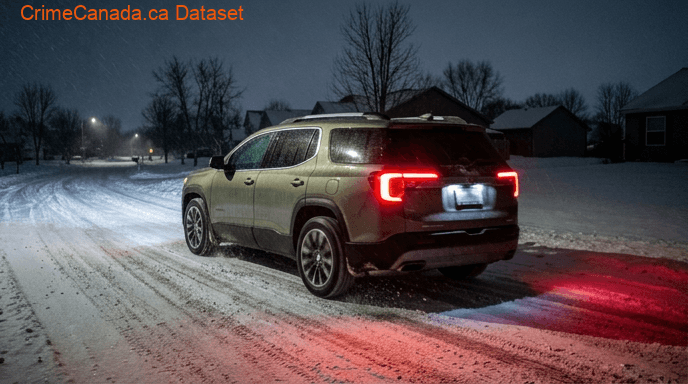
- A silver GMC Terrain, believed to be a 2024–2026 model.
- A Ford Escape, possibly an ST edition, believed to be a 2023–2026 model.
These vehicles are described as “newer models” and appear to be used as quick getaway transport once the suspects exit the homes.
Community Context & Social Sentiment
The impacted zone includes ravine-adjacent communities in southwest Edmonton such as those near Terwillegar Drive, and areas often associated with neighbourhoods like Terwillegar, Windermere, and Hodgson. These are generally considered stable, higher-income communities, where homes back onto ravines, multi-use paths, or wooded areas.
Geographically, the ravines create a mix of advantages and vulnerabilities. Mature trees and grade changes can offer privacy to residents, but they can also reduce sightlines to rear yards and make it easier for suspects to approach from the back of properties without being easily seen. Crescent and cul-de-sac street layouts off major corridors such as Terwillegar Drive can provide discreet spaces where vehicles can idle without drawing immediate attention.
Social media and community-discussion threads show a mixture of surprise and heightened caution. Residents note that southwest ravine communities do not typically appear in city crime spotlights, which has amplified concern. One commonly expressed theme is that the physical environment – ravine access, walking trails, and rear lanes – may inadvertently provide potential offenders with cover or escape routes in the evening hours. Another repeated sentiment is that, because homes seem to be selected at random, long-time residents who previously felt insulated from property crime are now reconsidering their security habits, especially when away during dinner or early evening outings.
Despite the alarm, current information indicates these incidents are confined to property crime, with no reports of direct confrontations or violence against occupants linked to this specific series. The pattern, as described by EPS, is that suspects carefully avoid homes when people are inside, focusing instead on fast, low-contact thefts.
How This Fits Into Edmonton’s Broader Crime Picture
Context from citywide data helps explain why this string of break-ins is drawing attention. Open-source analysis of Edmonton crime statistics from early 2024 through August 2025 shows roughly 22,800 residential and commercial break-ins reported during that period. Property offences in general make up around 60% of all reported crime in the city, even though the overall crime rate in 2024 fell to its lowest point in nearly a decade.
Within that broader pattern, most property crime is spread across the city and often concentrated in historically higher-risk zones. By contrast, the southwest ravine communities where these seven break-ins occurred are not usually identified as major hotspots. That lower baseline makes a concentrated series more noticeable to both police and residents, particularly when it clusters over a short timeframe and shows a consistent method of entry and target selection.
Seasonal factors also matter. Break-ins in Edmonton typically trend upward during warmer months, when residents travel more and homes are left unoccupied for longer stretches. The fact that this series began in January – a time when many residents still travel for winter getaways or spend evenings away from home – fits the general pattern of offenders seeking properties that appear empty, with dark windows, uncleared snow, or accumulating mail as possible visual cues.
For southwest homeowners, the takeaway is less that the area has suddenly become unsafe overall, and more that organized, mobile property offenders are willing to target neighbourhoods previously perceived as lower risk, particularly those with homes that appear obviously unoccupied in the early evening.
Practical Safety Considerations for Residents
The EPS has highlighted several precautionary measures for residents in the Whitemud Creek and Blackmud Creek areas, many of which apply across the city:
- Use interior and exterior lighting (including timers or smart bulbs) so homes do not appear dark and unoccupied in the early evening.
- Avoid posting real-time travel plans or vacation photos on social media that clearly signal your home is empty.
- Arrange for a trusted neighbour, friend, or service to collect mail, remove flyers, and maintain walkways or snow while you are away.
- Consider alarm systems, cameras, and reinforced rear-entry points (windows, patio doors) – especially for homes backing onto ravines, paths, or alleys.
- Report suspicious vehicles idling for extended periods on crescents or cul-de-sacs, particularly if they resemble a newer-model silver GMC Terrain or late-model Ford Escape, as described by EPS.
These steps do not guarantee prevention, but they can reduce the chances of a home being selected as an easy, low-risk target by offenders who appear to be watching for unoccupied properties and quick rear access.
About This Report
This safety alert was generated by aggregating data from local authorities, community reports, and open-source intelligence. Our mission at Crime Canada is to provide citizens with localized safety data and context. We are not the original creators of the underlying news reports.
Primary Source: Information in this report was initially covered by News Staff for CityNews.
Additional Research & Context
- Original safety warning and incident details from the Edmonton Police Service media release on southwest residential break-ins, available via EPS Newsroom: https://www.edmontonpolice.ca/News/MediaReleases/residentialBEsMar3.
- Expanded community and neighbourhood context on ravine-area break-ins, including references to Terwillegar and nearby communities, summarized by Culture Alberta: https://www.culturealberta.com/articles/edmonton-police-warning-southwest-residents-after-seven-break-ins-near-ravine-communities.
- Additional regional news coverage echoing the EPS advisory and highlighting the suspect vehicles and entry methods is available from Heartland News: https://heartlandnews.ca/2026/03/04/eps-warn-of-break-and-enters-near-whitemmud-blackmud-creek-ravines/.