
Table of Contents
Etobicoke Hydro-Pole Crash Highlights Impaired-Driving and Road-Safety Risks
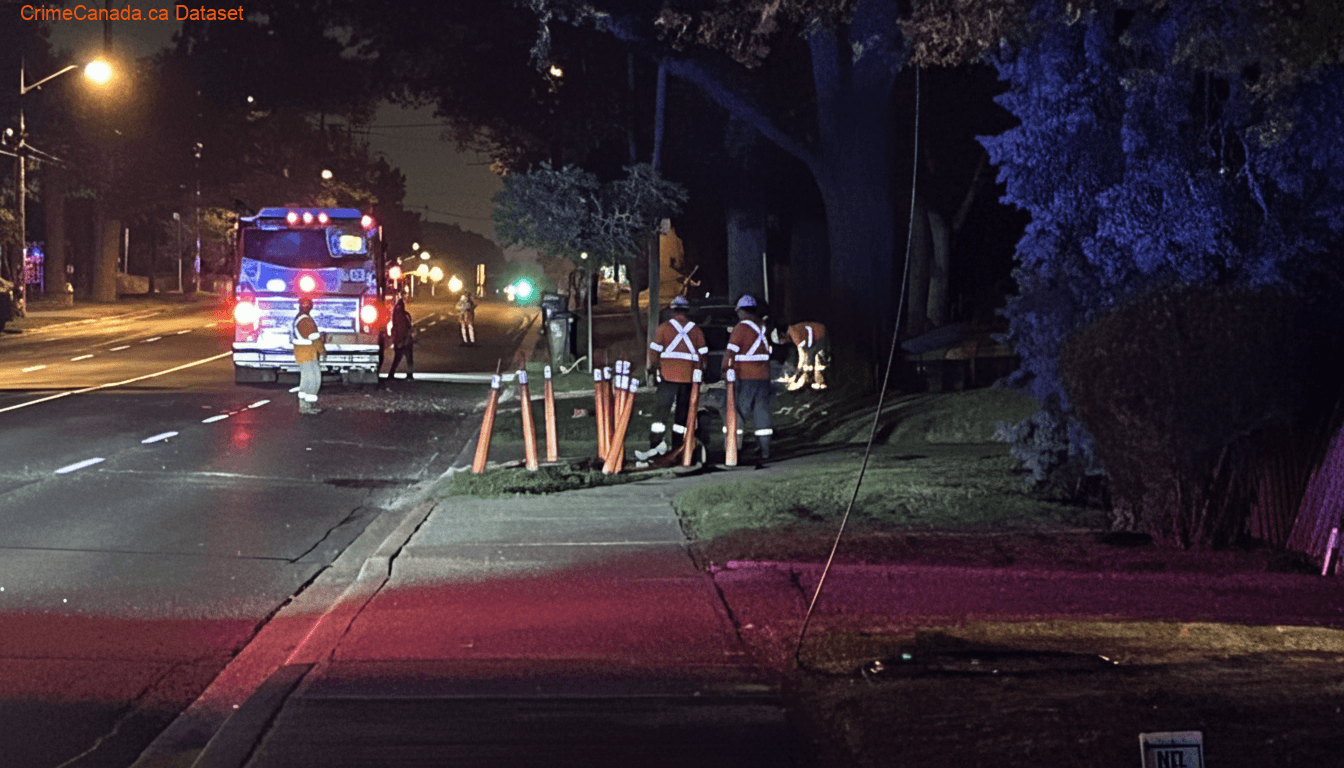
Toronto Police said a 21-year-old woman was arrested in connection with an alleged impaired-driving incident after a vehicle struck a hydro pole in Etobicoke. According to the initial report, officers were called shortly after 1:30 a.m. to the area identified as Islington Avenue and Aylesbury Road. The collision caused the pole to fall and left live electrical wires exposed near a TTC bus.
No injuries were reported in the initial account. Police said the driver was arrested at the scene, while debris was removed and roads in the area reopened at about 4 a.m. The available follow-up research has not identified a public Toronto Police Service release matching the stated intersection, nor any reported update on formal charges, court proceedings, or the identity of the driver. That research also notes similar but separate Etobicoke pole collisions near Islington Avenue; those incidents should not be treated as confirmation that they involve this case.
Community Context and Social Sentiment
Community discussion around comparable Etobicoke crashes has centred on frustration with alleged impaired driving, high-speed driving, and the repeated disruption caused when vehicles strike roadside infrastructure. Comments reviewed in open public forums commonly describe concern that collisions involving poles, traffic signals, or utility equipment can quickly affect more than the people inside a vehicle: they can create electrical hazards, disrupt transit, close intersections, and potentially interrupt power service.
Public reaction to similar incidents has broadly called for stronger prevention, more visible enforcement, and safer driving behaviour on major arterial routes.
The reported location falls within the broader Islington Avenue corridor, a busy north-south route serving residential areas, commercial destinations, and transit traffic. Investigative research identified other recent collisions in Etobicoke involving hydro poles or related infrastructure, including incidents near Islington Avenue and Rathburn Road, The Westway and Hartsdale Drive, and other major routes such as Royal York Road, Dixon Road, Renforth Drive, and The Queensway. The events differ in circumstances and severity, but together they illustrate how a loss-of-control crash can create risks beyond the initial impact.

For residents, the immediate safety concern after a pole strike is not only traffic congestion. Downed lines and damaged electrical equipment should be treated as potentially energized. People should remain clear of the scene, avoid touching wires or nearby objects, and follow directions from police, fire crews, transit officials, and utility workers. Motorists should also expect that road closures may remain in place until electrical hazards and debris have been assessed.
Statistical Overview: Infrastructure Collisions Carry Wider Public Costs
This incident is an alleged impaired-driving case, not a measure of crime trends on its own. The available material does not provide a verified citywide number for impaired-driving offences or collisions for the period in question, so no numerical trend should be inferred from this single event. However, the broader research shows a recurring road-safety pattern in Etobicoke and elsewhere in Ontario: collisions with hydro poles, traffic lights, and other fixed roadside objects can produce serious injuries, extensive closures, and utility disruptions even when no one is initially reported hurt.
Recent comparable reporting referenced a collision near Royal York and Dixon that damaged multiple hydro poles and affected roughly 1,500 customers at its peak. Another crash near Highway 427 and Renforth Drive reportedly knocked down a pole and traffic lights and left one person seriously injured. A separate alleged impaired-driving collision near The Westway and Hartsdale reportedly disrupted traffic signals and required a lengthy intersection closure. These examples do not establish a single cause or common offender profile, but they demonstrate the public-safety consequences of collisions involving roadside utility infrastructure.
Readers comparing local safety information across Ontario can also review Pickering crime statistics and safety data. Municipal crime data should be read alongside road-collision, traffic-enforcement, and emergency-response information, since traffic harms and criminal-offence measures are collected and reported differently.
The practical prevention message remains consistent: do not drive after consuming alcohol or drugs, plan a sober ride in advance, reduce speed for conditions, and give emergency scenes a wide berth. In cases involving damaged utility equipment, a non-injury outcome can still represent a significant public hazard.
About This Report
This safety alert was generated by aggregating data from local authorities, community reports, and open-source intelligence. Our mission at Crime Canada is to provide citizens with localized safety data and context. We are not the original creators of the underlying news reports.
Primary Source: Information in this report was initially covered by Denio Lourenco for CityNews.
Additional Research & Context
- CityNews Toronto has published reporting on comparable Etobicoke collisions involving hydro poles and roadway closures.
- CTV News Toronto has also covered serious Etobicoke collisions involving utility poles and ride-share vehicles.
- Toronto Police Service public information is a reference point for official updates when they are released.