
Table of Contents
Ottawa Speed Enforcement Nets 63 Charges as Extreme Speeds Raise Road-Safety Concerns
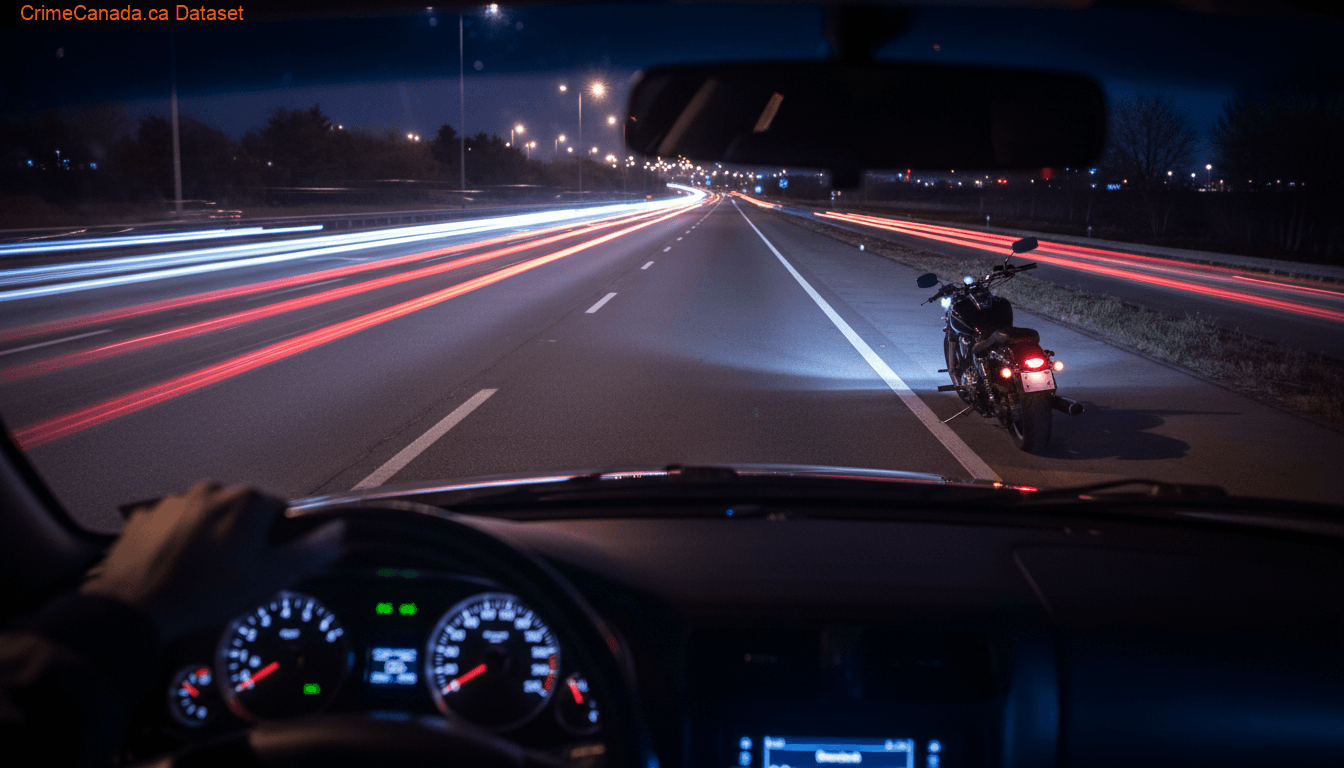
A joint evening traffic-enforcement operation by the Ontario Provincial Police (OPP) and Ottawa Police Service (OPS) resulted in 63 charges on roads in the Ottawa area on July 17 and 18. Police used multiple units, including the OPP aircraft, to identify alleged dangerous driving. The reported charges included 11 stunt-driving allegations, 35 speeding charges, five allegations of driving while suspended, two insurance-related charges and 10 other traffic offences.
Authorities reported several exceptionally high recorded speeds: 172 km/h in a 60 km/h zone, as well as 161 km/h and two instances of 186 km/h in 100 km/h zones. No collision victims were identified in connection with this enforcement operation. A review summarized in the available research found no public indication that the unnamed drivers in this particular operation have since faced upgraded charges, court outcomes or other case-specific updates.
Community Context and Social Sentiment
Discussion of recent high-speed enforcement in Ottawa-area online forums has been largely frustrated and safety-focused. Community members have questioned whether current sanctions sufficiently deter drivers who travel at extreme speeds, while others have welcomed visible enforcement. One anonymized commenter characterized repeated reports of 180 km/h-plus driving on Highway 417 as a sign that fines and short-term licence suspensions may not be changing behaviour. Another described 170 km/h in a 60 km/h zone as far beyond an ordinary speeding incident.
Those comments are public reaction rather than verified evidence of the scope of offending. Still, they reflect a practical concern: extreme speeding substantially reduces the time available for drivers to perceive hazards, brake or respond to other road users. The available reporting places the broader concern on highways, rural arterial roads and other higher-speed corridors around Ottawa, including routes associated with Highway 417, Highway 416, Carp and areas south and east of the city. The safety profile described in this case is traffic-related; the supplied research identified no link between these stops and other forms of violent crime at the enforcement locations.

For residents looking to place road-safety concerns alongside wider local indicators, Crime Canada’s Ottawa crime statistics and safety data and the regional Ottawa-Gatineau safety report provide broader context. General crime measures should not be treated as a direct measure of speeding risk: traffic enforcement data, collision data and criminal-offence statistics track different issues.
What the Charges May Mean
Ontario’s stunt-driving rules generally capture driving 50 km/h or more above the limit where the posted limit is below 80 km/h, and driving at 150 km/h or more where the limit is 80 km/h or higher. Based on the speeds reported, the alleged conduct in this operation exceeded those thresholds. Whether an individual is convicted, and which offence ultimately applies, remains a matter for the investigative and court process.
Local reporting also says Ottawa-area OPP officers consulted with the Crown about pursuing a Criminal Code dangerous-driving charge for speeds above 180 km/h, rather than relying only on provincial traffic offences. That statement describes an enforcement approach, not a confirmed criminal charge against any driver stopped during this operation. The source material does not identify the drivers, so individual histories, prior allegations and case dispositions cannot be independently assessed from the available information.
Statistical Overview
This operation fits a continuing pattern of targeted speed enforcement rather than a single isolated event. Recent Ottawa-area reports have described repeat stunt-driving allegations, high-speed stops on rural roads and concentrated OPP activity south of the city. In one separate Carp case, police reported a vehicle travelling 112 km/h in a 60 km/h zone; that incident should not be assumed to involve anyone from the July 17-18 operation.
At a broader level, the research supplied with this brief notes that recent provincial crime indicators have moved differently from public concern about visible dangerous driving: overall crime-rate and Crime Severity Index measures may decline while highly visible high-speed incidents continue to generate serious safety concerns. There is no centrally published, current 2026 total for stunt-driving charges specific to Ottawa in the material reviewed. As a result, the 63 charges reported here are best understood as the outcome of one focused operation, not as a citywide rate or a measure of all dangerous driving in Ottawa.
For road users, the immediate prevention message is straightforward: leave space, avoid escalating confrontations with aggressive drivers, report an active danger through emergency channels when appropriate, and provide police with only details that can be safely observed. Enforcement operations can remove some immediate risks, but safe speeds and predictable driving remain the primary protections for everyone sharing Ottawa roads.
About This Report
This safety alert was generated by aggregating data from local authorities, community reports, and open-source intelligence. Our mission at Crime Canada is to provide citizens with localized safety data and context. We are not the original creators of the underlying news reports.
Primary Source: Information in this report was initially covered by Natasha O’Neill for CityNews Ottawa.
Additional Research & Context
- CityNews Ottawa reporting on repeat stunt-driving allegations provides local enforcement context.
- CityNews Ottawa coverage of a separate high-speed stop in Carp illustrates similar roadway-safety concerns.
- CityNews Ottawa reporting on OPP stunt-driving enforcement south of Ottawa offers additional regional context.