
Table of Contents
RCMP charges Caledon resident after seven fake passports seized at Pearson
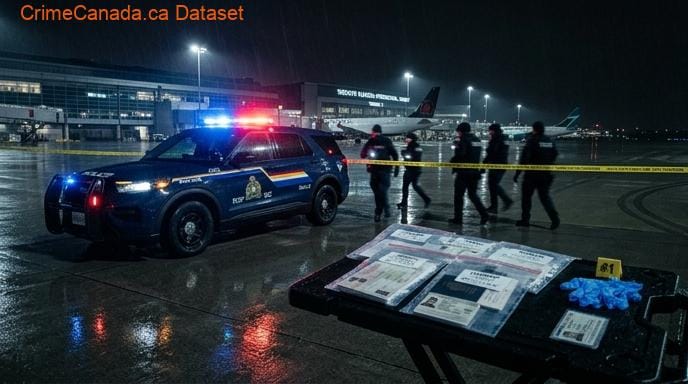
Federal RCMP investigators have charged a Caledon, Ontario resident after officers with the Canada Border Services Agency (CBSA) uncovered multiple fraudulent passports in a commercial shipment processed at Toronto Pearson International Airport. The discovery was made when border officials examined an inbound cargo load and located suspicious travel documents hidden inside footwear.
The case, originating from a shipment arriving from Nigeria, led to the seizure of seven allegedly fake passports and the arrest of one individual. Following the border agency’s initial enforcement actions, the matter was transferred to the RCMP Federal Policing – Central Region, which has now laid a criminal charge connected to the possession of forged passports.
Official details of the incident
According to the RCMP, the investigation started when a CBSA Border Services Officer selected a commercial shipment weighing approximately 1,600 kg, originating from Nigeria, for a detailed examination at Toronto Pearson International Airport commercial operations. During this inspection, officers discovered seven concealed travel documents hidden inside sandals.
Border services officers determined that all seven passports appeared fraudulent. Five of the documents were purportedly issued by the Republic of the Gambia, and two by South Africa. Each passport contained the same male photograph but different identities and inconsistent personal details, which is a strong indicator of document fraud used to conceal true identity or facilitate unlawful travel.

The CBSA placed the involved individual under arrest and seized the forged passports along with additional items believed to be connected to the alleged offence. The RCMP Toronto Airport Detachment – Border Integrity Unit then assumed conduct of the investigation and proceeded with criminal charges.
Charges laid
The following charge has been laid in relation to this incident:
- Accused: Nnenna Oketa, 44, of Caledon, Ontario
- Charge: Knowingly possessing a forged passport, contrary to section 57(3) of the Criminal Code of Canada.
Investigators emphasize that these are allegations only, and the charge has not yet been proven in court. The accused is presumed innocent unless and until found guilty by a court of law.
Document fraud and border security
Cases involving forged passports and falsified travel documents are a serious concern for Canadian border and policing partners. Fraudulent identity documents can be used to evade immigration controls, facilitate organized crime, or support other unlawful activities. By intercepting such items at the border, agencies like the CBSA and RCMP aim to reduce the risk of identity-based crime throughout Canada.
CrimeCanada.ca tracks incidents of border-related crime as part of our mission to provide national safety awareness. For readers interested in broader national patterns and enforcement activity, you can review ongoing coverage in our National Crime News and border enforcement reports. We also publish localized crime and safety data for communities across the country, similar to the profiles available for smaller jurisdictions such as Portier Pass 5 crime statistics and safety information, to help residents understand risks in their own regions.
CrimeCanada.ca safety perspective
From the perspective of CrimeCanada.ca, this alert matters to the Ontario community because document fraud at major transportation hubs like Toronto Pearson International Airport can ripple far beyond the airport itself. Illegitimate identity documents may enable individuals to move anonymously through communities, complicating criminal investigations and potentially supporting other offences, from financial fraud to organized crime.
Community safety is strengthened when residents remain alert to potential identity and document scams in everyday life. While most people will never encounter forged passports directly, you may encounter suspicious identification during private transactions, rental agreements, or employment screening. Consider the following general safety practices:
- Be cautious when dealing with identification that appears altered, damaged, or inconsistent with the person presenting it.
- For employers and landlords, use formal verification processes where possible instead of accepting photocopies or low-quality images of key ID documents.
- If you suspect the use of forged travel or identity documents, do not confront the individual directly. Instead, make detailed notes of what you observed and report your concerns to local police or the RCMP through non-emergency channels.
Incidents like this underline the importance of coordinated efforts between border agencies, police, and informed community members. By staying aware of how identity fraud can be used as a gateway to other crimes, Ontarians can contribute to a safer province.
Official Source & Community Safety
This safety alert is based on an official release from the Royal Canadian Mounted Police (RCMP). CrimeCanada.ca aggregates and analyzes this data to keep the ontario community informed, aware, and safe. We are an independent safety data aggregator and not the original creators of the underlying incident report.
Read the full official release here: RCMP Official Statement.