
Table of Contents
Scarborough Domestic Stabbing Renews Focus on Home Safety and Support Services
Section 1: What Happened
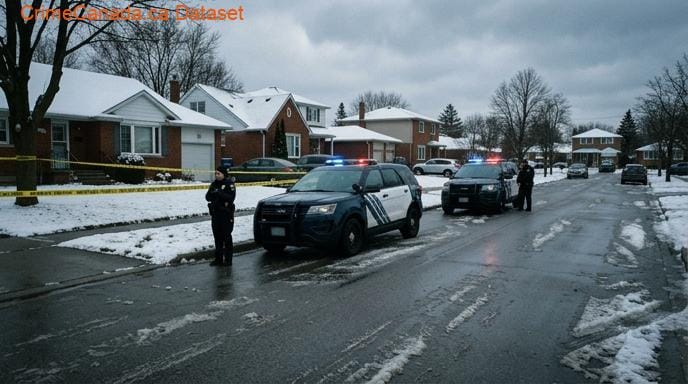
On a late Saturday morning in Scarborough, near the intersection of Manse Road and Lawrence Avenue East, police responded to a reported domestic incident inside a private residence. Officers from the Toronto Police Service arrived shortly before noon after receiving calls about a possible stabbing.
Paramedics located an adult woman inside the home with multiple stab wounds. She was transported to hospital with serious but reportedly non-life-threatening injuries. A 30-year-old man, believed by police to be related to the victim, was taken into custody at the scene. Authorities have described the event as a domestic dispute and indicated that everyone involved was known to each other. As of the latest available open-source information, no formal charge list, victim identity, or additional investigative details have been publicly released.
Section 2: Community Context & Social Sentiment
The incident unfolded in a largely residential pocket of Scarborough that has not recently been highlighted for repeated violent incidents. While there is no specific history of similar attacks at this exact address or intersection in the last year, the event contributes to broader concerns about intimate-partner and family-related violence occurring behind closed doors, often without prior public warning signs.
Online reaction to Toronto’s broader crime picture in recent months has been a mix of relief and resignation. Some commentators point to declining rates in several major crime categories and argue that the city overall has become safer, even as isolated but serious incidents like this one still occur. Community discussion often acknowledges that statistics may show progress, yet individual cases of domestic violence remain deeply troubling because they are difficult to predict and can escalate rapidly within private homes.

Residents in suburban parts of the Greater Toronto Area sometimes compare their own neighbourhoods to nearby municipalities using crime dashboards and statistical reports. For example, people tracking trends east of Toronto may look at data for communities such as Pickering’s crime statistics and safety data or smaller Ontario towns like Scugog’s crime and safety profile to understand how local risk levels align or differ. These comparative tools can help situate a single serious event, like the Manse Road domestic stabbing, within a wider pattern of generally low day-to-day risk for random attacks, while underscoring that domestic violence is often driven by household dynamics more than neighbourhood crime conditions.
In the wake of such incidents, community advocates typically emphasize the importance of recognizing warning signs of domestic abuse, including escalating arguments, controlling behaviour, and threats of violence. Residents are encouraged to contact police or victim-support services if they suspect that someone in their circle is at risk, even when conflicts appear to be “just family issues.”
Section 3: Statistical Overview & How This Fits Toronto Trends
This case is best understood in the context of Toronto’s recent crime trends rather than as a stand-alone indicator that the neighbourhood is unsafe. City-wide data for 2025 show a complex picture: some categories of violent crime rose year-over-year, but by the end of the period, several key indicators had declined compared with the prior year.
According to publicly summarized statistics, overall violent crime in Toronto was initially reported as having risen compared to 2024, with assaults and robberies among the most frequently reported offences. However, by year-end, more detailed breakdowns showed that reported assaults were down by roughly 11%, robberies fell by around 19%, and the city recorded 38 homicides—a sharp drop of more than half compared with 2024, and the lowest homicide count in roughly two decades. Stabbings accounted for about one-third of those homicides. Non-fatal stabbing assaults, like the one reported at Manse Road and Lawrence Avenue East, are not always broken out separately in public summaries, but they form part of the broader assault category.
At the same time, property-related crime showed signs of easing, with modest decreases reported in categories like break-ins and overall property offences. There were also notable declines in auto theft and firearm-related deaths, with some analyses pointing to nearly a 50% drop in vehicle thefts and the lowest number of gun fatalities in several years. These changes suggest that while certain high-profile incidents draw attention, day-to-day risk for many types of street crime has been trending downward.
Domestic incidents, however, often follow a different pattern than public assaults or robberies. They tend to occur in private settings, may involve ongoing interpersonal conflict, and sometimes never come to police attention until a serious act of violence has already taken place. Suburban areas like Scarborough can therefore simultaneously show improvements in general crime indicators while still experiencing sporadic, severe domestic assaults that are tied to individual households rather than to broader street-level crime trends.
Comparing these Toronto trends with data from smaller jurisdictions—rural municipalities in Saskatchewan such as Cut Knife No. 439’s crime statistics and safety profile, for example—highlights how population density and urban pressures influence the types of offences most commonly reported. Larger cities typically report more assaults and domestic disputes in absolute terms, simply due to their size, even when per-capita risks are stable or improving.
For residents near Manse Road and Lawrence Avenue East, the available evidence suggests that this incident appears to be contained to a specific domestic setting rather than a sign of a broader public-safety breakdown in the area. Nonetheless, it underscores that support systems—such as shelters, counseling services, and accessible reporting channels—remain critical pieces of community safety, particularly for individuals living with escalating conflict at home.
About This Report
This safety alert was generated by aggregating data from local authorities, community reports, and open-source intelligence. Our mission at Crime Canada is to provide citizens with localized safety data and context. We are not the original creators of the underlying news reports.
Primary Source: Information in this report was initially covered by Denio Lourenco for CityNews.
Additional Research & Context
- For a narrative summary of how Toronto’s 2025 crime picture shifted, including declines in homicides and robberies, see the analysis on city safety trends published on Substack: “Good work, everyone: Toronto was safer in 2025.”
- For breakdowns of Toronto’s 2025 homicide numbers, methods (including stabbings), and year-over-year comparisons, consult the overview provided by Protection Plus at How many murders have there been in Toronto in 2025?
- For an aggregated look at violent crime, property crime, and crime-severity trends in Toronto during 2025, including percentage changes in assaults and robberies, see the statistical review compiled by CBLaw at Toronto Crime Statistics 2025.