
Table of Contents
Backcountry Safety Alert: Whitehorse RCMP Airlift Stranded Cross‑Country Skiers Near Mount Arkell
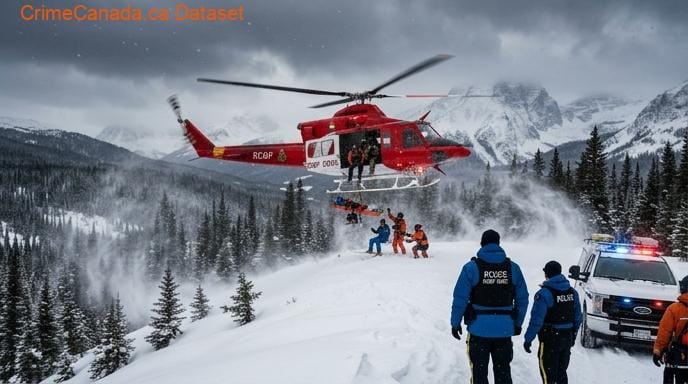
On March 24, 2026, Whitehorse RCMP coordinated a helicopter rescue of two cross‑country skiers who were stranded in the Mount Arkell backcountry after a multi‑day trip became unsafe. The incident involved a father and son who activated an emergency SOS device when they realized they could not safely continue or return along an alternate route.
The pair had departed on a multi‑day ski route in the Mount Arkell area, west of Whitehorse, Yukon. On March 23, 2026, they encountered terrain they could not safely navigate and, after retreating, determined they lacked the supplies needed for a safe return to Whitehorse via a different path. Their decision to use an emergency communication device allowed RCMP Search and Rescue to quickly coordinate an air extraction and prevent the situation from escalating into a medical or survival emergency.
Official Incident Details
According to the official information provided by Yukon RCMP, the sequence of events unfolded as follows:
- March 23, 2026 – 2:14 p.m. (approx.): Whitehorse RCMP received a Garmin inReach SOS activation from a father and son on a multi‑day cross‑country ski trip in the Mount Arkell area.
- The skiers reported that they had reached an unexpected impasse on their planned route and were forced to turn back due to difficult and unsafe terrain.
- After assessing their situation, they determined they did not have enough supplies to safely reach Whitehorse using an alternate route.
- An RCMP Search and Rescue Manager was engaged to oversee the response and coordinate specialized resources.
- March 24, 2026: A coordinated helicopter extraction was carried out in the Mount Arkell backcountry.
- Shortly after 2:00 p.m. on March 24, 2026, both individuals were safely airlifted and transported back to Whitehorse.
- RCMP confirm that both skiers were uninjured and did not require medical treatment.
Yukon RCMP are using this incident to stress the importance of layered preparation for remote winter travel. They highlight that the presence of a reliable emergency communication device, in this case a Garmin inReach, was a key factor in enabling a fast and coordinated rescue in challenging winter conditions.

RCMP Search and Rescue Manager Corporal Chris Faulkner emphasized that even well‑prepared and experienced backcountry users can encounter unexpected hazards. He noted that the current winter has produced unusually high snowfall for this time of year, raising the overall risk profile for backcountry travel in Yukon and increasing the potential consequences when routes become blocked or conditions rapidly change.
For residents and visitors planning activities that start or end in or near the city, reviewing local risk trends can be helpful. Data from the Whitehorse Crime Statistics & Safety Report provides broader context on emergency response and public safety patterns in the area.
CrimeCanada.ca Safety Perspective
From the perspective of CrimeCanada.ca, this incident underscores how quickly a routine recreational outing in Yukon’s backcountry can evolve into a rescue operation, especially during heavy‑snow winters. While no crime is involved here, search and rescue deployments are a critical part of the territory’s overall safety landscape and place significant demand on emergency services that also respond to other public safety incidents in and around Whitehorse and the surrounding region.
For anyone travelling in remote areas of Yukon, CrimeCanada.ca encourages the following safety practices:
- Carry at least one emergency communication device (such as a satellite messenger, PLB, or inReach) and know how to use it.
- Build in a margin of safety with extra food, water, and warm clothing in case of delays or route changes.
- Share a detailed trip plan with a trusted contact, including your route, expected return time, and contingency plans.
- Regularly check avalanche forecasts, weather conditions, and local advisories before entering mountainous or high‑snow areas.
- Recognize that even experienced travellers can be forced to turn back; planning escape routes and decision points before departure can reduce risk.
Our mission is to support a safer Yukon by connecting official alerts like this with practical guidance and data. For a broader view of safety patterns in the area beyond city limits, you can also review the Whitehorse, Unorganized, Yukon safety and crime statistics, which help illustrate how remote travel, sparse infrastructure, and long response distances shape overall community risk.
Official Source & Community Safety
This safety alert is based on an official release from the Royal Canadian Mounted Police (RCMP). CrimeCanada.ca aggregates and analyzes this data to keep the yukon community informed, aware, and safe. We are an independent safety data aggregator and not the original creators of the underlying incident report.
Read the full official release here: RCMP Official Statement.