
Table of Contents
Prince George 9-1-1 Police Dispatchers: Inside a Critical Lifeline
In Prince George, British Columbia, 9-1-1 police dispatchers form a vital lifeline between the public and frontline officers across a vast northern region. Working out of a busy dispatch centre, they answer emergency calls, gather critical information, and coordinate police responses for communities stretching from 100 Mile House to the B.C./Yukon and B.C./Alberta borders, and west to the Queen Charlotte Islands.
This RCMP profile highlights a typical shift for dispatchers in the North District Operational Communications Centre, including their demanding 12-hour day and night rotations, the technology they rely on, and the emotional load of handling high-risk and distressing calls. It also recognizes their contribution during National Public Safety Telecommunications Week, when the Prince George RCMP publicly thanks 9-1-1 police dispatchers locally and across Canada.
Official Details About North District 9-1-1 Dispatch Operations
The RCMP’s 9-1-1 dispatch centre in Prince George manages police calls for the area known as North District, which covers a large portion of northern British Columbia. Key operational details include:
- Dispatchers typically work a four-on, four-off rotation: two 12-hour day shifts followed by two 12-hour night shifts.
- Their first day shift begins at 7:00 a.m., starting with setting up their desk and systems to be ready for emergency calls.
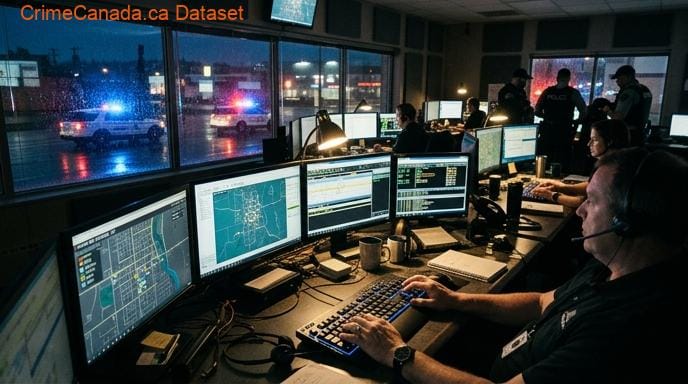
- Each dispatcher is stationed at a large sit-stand console with approximately five to six monitors, each providing different real-time information such as incoming calls, unit locations, and officer status.
- Dispatch responsibilities are rotated between different geographic areas in North District so that no dispatcher is always assigned to the busiest zones and everyone gains experience with a range of call types.
- The dispatch area served includes communities from 100 Mile House north to the B.C./Yukon border, west toward the Queen Charlotte Islands, and east to the B.C./Alberta border.
One dispatcher, Brett, has been a 9-1-1 police dispatcher for seven years and notes that in Prince George, the flow of calls is constant and the work rarely slows. Despite the intensity, he emphasizes that when a shift ends, dispatchers usually do not take operational tasks home, helping maintain a boundary between work and personal life.

Another experienced dispatcher, Jenna, who has worked in the role for sixteen years, describes ideal dispatcher qualities as being detail oriented, positive, and resilient. This reflects the need to stay focused under pressure, remain calm and reassuring to callers, and manage the mental stress of repeated exposure to emergencies.
Mental Health and Support for Dispatchers
The RCMP highlights dedicated support systems in place for dispatchers who handle particularly intense or violent calls. According to North District Operational Communications Centre management, when dispatchers experience high-risk or highly stressful incidents, they are offered a critical incident debrief to process what occurred.
- A comprehensive Employee Assistance Program is available to help dispatchers manage stress, emotional reactions, and any lingering impact from serious calls.
- These supports are intended to ensure that dispatchers do not feel they must cope with difficult incidents alone.
- Supervisors encourage the use of these resources following traumatic or violent events.
During National Public Safety Telecommunications Week, the Prince George RCMP Detachment formally acknowledges the dedication and hard work of 9-1-1 police dispatchers serving both Prince George and communities across Canada.
For residents who want to better understand the environment in which these dispatchers work, current Prince George crime statistics and safety data can help illustrate why emergency communication services remain so crucial to the region’s overall safety.
CrimeCanada.ca Safety Perspective
From the perspective of CrimeCanada.ca, this RCMP feature underscores how essential 9-1-1 police dispatchers are to public safety in British Columbia, particularly in large and diverse regions like North District. They are often the first trained professionals to interact with people in crisis, guiding callers through life-threatening situations while coordinating a rapid police response.
Residents can support safer communities by using 9-1-1 responsibly—reserving it for emergencies where immediate police, fire, or medical assistance is needed—and by staying calm, clear, and patient with dispatchers when they call. In high-stress moments, answering questions precisely and following the dispatcher’s instructions can significantly improve response effectiveness. Understanding local crime patterns, through resources like the Prince George area crime and safety overview, can also help citizens prepare for risks and know when it is appropriate to contact emergency services versus non-emergency lines. Supporting dispatcher wellness and respecting their role ultimately strengthens the entire public safety network in northern B.C.
Official Source & Community Safety
This safety alert is based on an official release from the Royal Canadian Mounted Police (RCMP). CrimeCanada.ca aggregates and analyzes this data to keep the british-columbia community informed, aware, and safe. We are an independent safety data aggregator and not the original creators of the underlying incident report.
Read the full official release here: RCMP Official Statement.